English
 Deutsch
 Italiano
 Français
 Português
 ไทย
ไทย
 Tiếng Việt
 Polski
 Türkçe
 Nederlands
 Română
 한국어
한국어
 Svenska
 Español
Finding the best funded trader programs in 2026 means cutting through hundreds of options to find genuine funded accounts with a proven payout history — and then figuring out which one actually fits how you trade. Top-rated prop firms aren’t always the loudest ones. Some of the most legit prop trading firms run lean evaluations with no personal risk, institutional liquidity, and clean track records that only show up in community reviews, not on their own landing pages.
This guide compares the top programs by asset class, because the firm that lets you scale your trading on forex may not even support futures. If you want to trade firm’s capital with a high profit split and stay funded long-term, the details in these tables are what actually matter.
Top-Tier Funded Accounts by Asset Class
The tables below are organized by what a firm supports — not by size or reputation. Check which asset class matches your strategy first, then evaluate the specific rules.
For Forex & CFDs Trading Accounts (MetaTrader/cTrader Focused)
Forex and CFD programs are the most saturated segment of the market, which means both more options and more variation in quality. The firms below represent the tier with the most consistent evaluation structures and verifiable payout histories as of 2026.
Most programs in this category use static drawdown after Phase 1 — your loss floor stays fixed at the initial balance level regardless of profits made during the evaluation. This is a meaningful structural advantage over trailing drawdown programs (explained further below).
| Firm | Account Sizes | Profit Target | Max Daily Drawdown | Max Total Drawdown | Spread Type | Commission | Profit Split | Payout Cycle | Platforms | Weekend Holding |
|---|---|---|---|---|---|---|---|---|---|---|
| FTMO | $10K–$200K | Phase 1: 10% / Phase 2: 5% | 5% (static) | 10% (static) | Raw / Standard | From $3/lot (raw) | 80–90% | On-demand (after 14 days) | MT4, MT5, cTrader | Allowed |
| FundedNext | $6K–$200K | Phase 1: 10% / Phase 2: 5% | 5% (static eval) | 10% (static eval) | Raw / Standard | Plan-dependent | 80–95% | 5-day minimum cycle | MT4, MT5 | Allowed (most plans) |
| Fundora | $16,666–$400K | Phase 1: 8% / Phase 2: 5% | 5% Static | 8% Static | Standard | N/A | 80% | First payout after 28 days, then 14-day cycle | cTrader | Allowed |
Key differences for forex/CFD selection:
Spreads matter more than most comparison articles acknowledge. Raw spread programs charge commission per lot but offer tighter fills; standard spread programs include the commission in the spread. For scalping strategies, raw accounts with commission are almost always cheaper per round trip — but confirm the actual commission figure, not just the label. FTMO’s commission structure on raw accounts is publicly documented; FundedNext’s varies by plan.
Payout cycle timing is the other frequently underweighted variable. A 14-day minimum cycle means a trader who passes on day 1 of the funded stage must trade 13 more days before their first withdrawal. During those 13 days, every rule still applies. Programs that offer 7-day cycles are not just faster — they reduce the compounded risk exposure before the first payout.
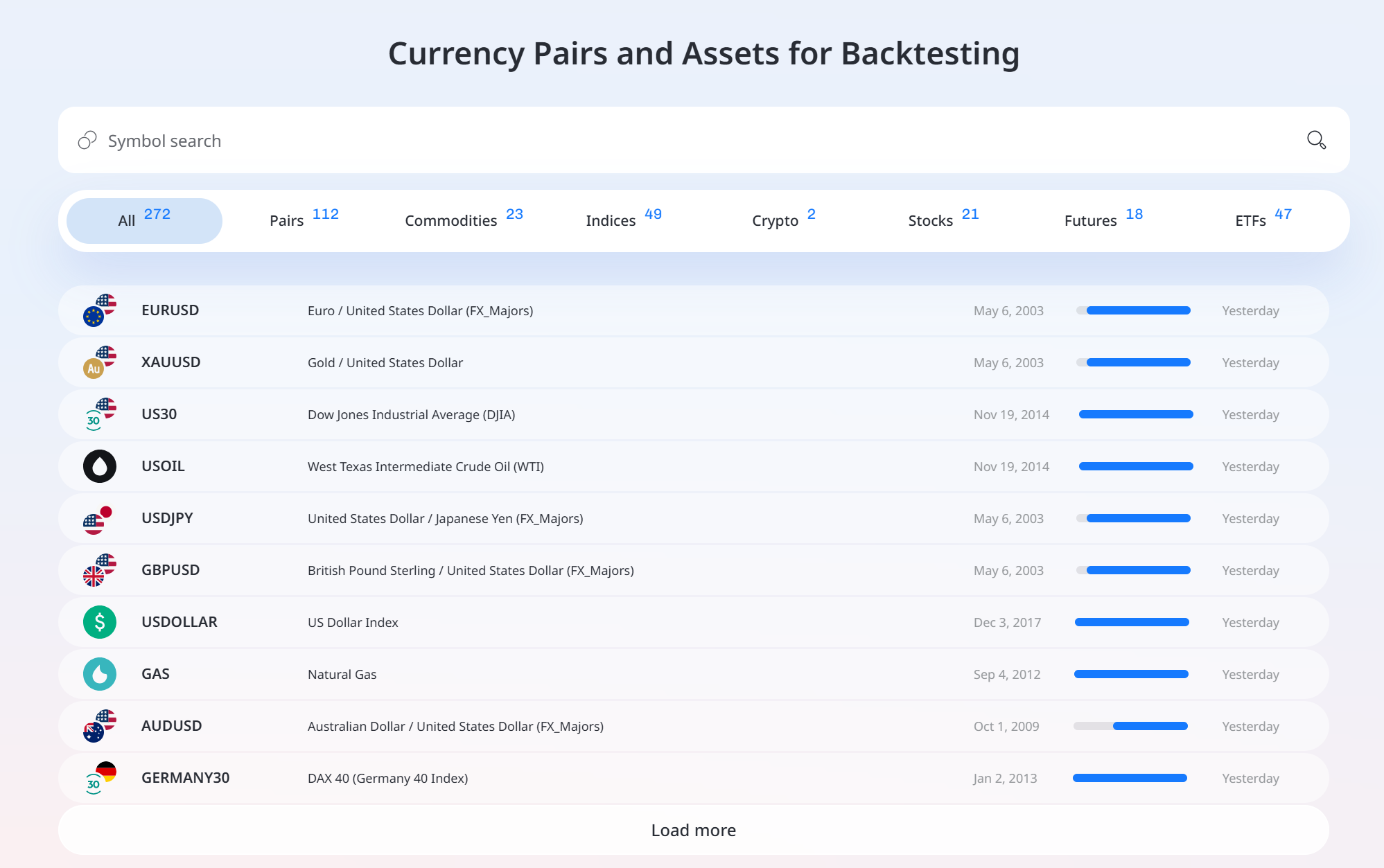
Before committing to any of the programs above, it’s worth running your strategy against their exact rules in a simulator first. Forex Tester Online (FTO) is a browser-based backtesting and prop challenge simulator — no installation required — that lets you configure any firm’s specific parameters: profit target, daily loss limit, total drawdown limit. It runs on 23+ years of tick-by-tick historical data across 280+ instruments including all major and minor forex pairs, with customizable spread and commission settings. This means you can model the exact execution costs of whichever firm you’re targeting, not a generic approximation, before paying the entry fee.
For Futures Traders Accounts (CME/CBOT Focus)
The most important practical difference between futures programs and forex/CFD programs isn’t the asset — it’s the drawdown convention that has become standard across each space.
In forex/CFD programs, most evaluation phases use static drawdown: your floor is fixed at the starting balance and doesn’t move regardless of profits. In futures programs, nearly all firms use trailing drawdown by convention — the floor rises with your highest realized or unrealized equity. This isn’t a technical requirement of futures markets; it’s an industry norm. But it’s almost universal enough that when you choose a futures program, you should assume trailing drawdown unless the firm explicitly states otherwise. The implication is significant: the better you do early, the more compressed your cushion becomes.
The arithmetic is worth internalizing. On a $50,000 account with a $2,500 trailing drawdown limit, you start with $2,500 of buffer. If you trade up to $52,000 and then give back $2,600 in one session, your account is closed — even though you’re still $1,400 in profit from the starting balance. That’s the trailing mechanics at work: the floor moved up to $49,500 when you hit $52,000.
This is why tick-by-tick simulation is especially important when preparing for any trailing drawdown program — and since almost all futures programs use trailing, that means futures preparation specifically. Evaluations are terminated on equity — including unrealized P&L on open positions — and equity can touch the floor mid-candle in ways that bar-based replay tools never reveal.
| Firm | Account Sizes | Monthly Fee | Profit Target | Trailing Drawdown | Max Contracts (ES) | Platforms | News Trading |
|---|---|---|---|---|---|---|---|
| Topstep | $50K–$150K | $165–$375 | $3,000–$4,500 (6%) | $2,000–$3,000 (EOD) | 5 (50K account) | NinjaTrader, Tradovate, TopstepX | Restricted |
| Apex Trader Funding | $25K–$300K | $147–$657 | 6% | Trail from start | Up to 10 (50K) | NinjaTrader, Tradovate, Rithmic | Allowed (most plans) |
| My Funded Futures | $50K–$150K | $165–$475 | 6% | EOD trailing | 5 | NinjaTrader, Tradovate | Plan-dependent |
EOD vs. intraday trailing drawdown — the distinction that ends most accounts
Topstep and My Funded Futures use End-of-Day (EOD) trailing drawdown: the floor adjusts once per day, based on your closing equity. This is meaningfully more forgiving than intraday trailing, because it doesn’t penalize you for unrealized losses mid-session that you recover before the close.
Apex uses intraday trailing by default, which means a strong morning followed by a choppy afternoon can compress your floor in ways that don’t appear until you check the numbers mid-session.
For traders preparing in Forex Tester Online: drawdown in the Prop Challenge Simulation is calculated on equity continuously — including unrealized P&L on open positions throughout the session. This is stricter than EOD-based programs like Topstep or My Funded Futures, which adjust the floor only once per day at close. It closely matches intraday trailing programs like Apex. The practical effect: if your strategy passes cleanly in FTO’s simulation, it has a built-in safety margin over EOD programs. Most traders discover during simulation that their natural position sizing brings them far closer to the floor than their balance ever suggested — exactly the information you need before paying a monthly evaluation fee.
For Crypto Specialists Accounts
Crypto programs occupy the smallest and most rapidly evolving segment. Two practical facts define most programs in this space: leverage is set significantly lower than in forex programs — typically 1:2 to 1:10, compared to 1:20–1:30 on forex — and the market operates 24/7, which means drawdown limits can be triggered on Sunday night as easily as during London open. Both are firm-level decisions, but they’re consistent enough across the category to treat as working assumptions until a specific program’s rules say otherwise.
| Firm | Instruments | Max Leverage | Profit Target | Daily Drawdown | Total Drawdown | Profit Split | 24/7 Payouts |
|---|---|---|---|---|---|---|---|
| BrightFunded | BTC, ETH, major alts | 1:2 (crypto) | 8–10% | 4–5% | 8–10% | 80–100% | Yes |
| Blue Guardian | BTC, ETH, select alts | 1:5 (crypto) | 8% | 4% (static) | 8% (static) | 90% | Yes |
The lower leverage in crypto is not a disadvantage in disguise — it’s a calibration requirement. A strategy designed for 1:30 forex leverage applied to 1:5 crypto will oversize every position by a factor of six, which means a drawdown that costs 1% in forex costs 6% in crypto. This is the most common reason forex traders who move to crypto programs fail their evaluations within the first three sessions.
The other variable specific to this category is weekend volatility. Bitcoin and Ethereum have historically produced some of their most significant intraday moves on weekends, when institutional liquidity is lower. Many traders set tighter personal daily loss limits — typically 2–3% versus the firm’s 4–5% limit — to leave themselves a buffer during low-liquidity windows.
Forex Tester Online lets you configure the exact leverage of your target firm when setting up a prop challenge simulation — so you’re not practicing with generic settings but with the actual 1:2 or 1:5 that the program applies. Combined with the Trade Analyzer, which identifies which days of the week and which sessions produce the most drawdown for your specific approach, you can build a clear picture of your Saturday risk exposure before it costs you a live evaluation.
One more feature worth using specifically for crypto: Blind Mode. Bitcoin and Ethereum carry strong emotional associations — most traders have a view on where they’re going, which contaminates pure price action reading. Blind Mode conceals the instrument identity and the date, so you’re trading structure, not a narrative. If your results hold up when you don’t know it’s BTC, you have real evidence that your edge isn’t just familiarity with how crypto tends to move.
The Selection Framework: Spotting the Right Program for Your Market
Two variables trip up traders most often when switching between programs or asset classes: leverage and platform. Both are firm-level decisions — but they have direct consequences for how you size positions and what software you need to trade.
Leverage Differences: Why Most Crypto Programs Require Different Risk Management Than Forex
The same risk-per-trade percentage produces very different outcomes when a firm sets different leverage limits for different assets — and most crypto programs do set it much lower than forex programs.
At 1:30 forex leverage, risking 1% of a $50,000 account per position means a stop of approximately 16 pips on a standard lot of EURUSD. At 1:5 crypto leverage, risking 1% of a $50,000 account means a stop of 1% of the BTC position value — which, at typical BTC volatility, can be hit within a single candle during a news spike.
The practical implication: position sizing rules cannot be transferred between asset classes. Each requires its own calibration, ideally through backtesting under the specific drawdown limits of the target firm.
For futures, leverage compounds differently because contract sizing is fixed. One ES contract on a $50,000 account represents roughly $250,000 of notional exposure — a leverage ratio that makes futures evaluation programs some of the highest-risk-adjusted evaluations available. The maximum contract limits (5 ES contracts on most $50K futures programs) exist precisely because the default leverage would otherwise make daily drawdown limits trivially easy to violate.
Platform Compatibility: From TradingView to NinjaTrader
Platform compatibility determines which broker’s execution environment you’re working within — and therefore which spreads, slippage, and order routing your results depend on.
For Forex/CFD programs: MT4 and MT5 are the most universal. cTrader programs (FTMO, FunderPro) offer a more modern interface and often better execution quality for automated strategies. If you use Expert Advisors or algorithmic entries, confirm EA compatibility specifically — not just “MT5 compatible,” but whether the firm allows automated execution at the funded stage.
For futures programs: NinjaTrader and Tradovate are the primary platforms. NinjaTrader requires a license (one-time or lease), Tradovate is subscription-based. Topstep’s own platform, TopstepX, is built specifically for their evaluation mechanics and includes built-in daily loss alerts that mirror the firm’s rules in real time.
For crypto programs: most use proprietary dashboards or connect to exchanges via API. Verify the execution environment before purchasing — “crypto funding firm” covers everything from firms running their own liquidity pool to those routing orders through a specific exchange.
Forex Tester Online is positioned as the preparation layer before any of these platforms — it replicates the conditions of the evaluation without being locked into any single firm’s execution environment. Once a strategy is validated in FTO, the transition to the actual platform (MT5, NinjaTrader, or a crypto dashboard) is a mechanics adjustment, not a strategy change.
Professional Preparation: Validating Your Strategy Before the Challenge
The industry statistic that over 90% of prop challenge attempts fail is real — but the failure mode is more specific than “bad strategy.” The most common reason evaluations get terminated is a drawdown violation caused by position sizing calibrated for the wrong number.
A trader who risks 2% per position on a $50,000 account with a 5% daily drawdown limit has exactly 2.5 average losses before hitting the daily cap. That’s not a lot of room during a choppy session. A trader who risks 0.5% per position has 10 average losses before the cap — enough to survive a genuinely bad day and come back the next.
The difference between those two sizing approaches is not discovered through intuition. It’s discovered through simulation.
Asset-Specific Backtesting: Why 20+ Years of Tick Data Is Vital for Forex vs. Futures
The reason tick-by-tick data quality matters more for some strategies than others comes down to how these firms measure drawdown.
Most programs measure drawdown on equity, not balance — meaning an open position floating at -$1,800 on an account with a $2,500 daily limit is already 72% of the way to termination before you’ve closed anything. Always confirm how your specific firm measures it: EOD programs like Topstep calculate the floor from closing equity, which means mid-session dips that recover before close don’t trigger a breach. Intraday programs do. The difference determines how much a tick-level simulator matters for your preparation.
For scalping strategies in futures or forex, where positions move through the daily limit zone and recover within minutes, this distinction is the entire difference between “my strategy is profitable” and “my strategy terminates prop accounts.”
Forex Tester Online uses real historical tick data across 23+ years of forex and crypto history, with futures data available. Tick-by-tick replay means mid-candle equity dips appear exactly as they would in a live evaluation — including the ones that would have ended the session.
Managing Drawdown Limits with Intelligent Analytics
After running a series of simulated challenge sessions, the question shifts from “did I pass?” to “why did I almost fail, and what needs to change?”
Forex Tester Online’s Trade Analyzer addresses this directly. It works from any number of trades, though 30+ gives the results statistical weight. It identifies:
- Which instruments in your approach produce the highest per-trade drawdown
- Which weekdays generate the most losing sessions (relevant for crypto traders managing weekend exposure)
- Which sessions — London open, New York overlap, post-NFP — most frequently produce drawdown spikes
These aren’t hypothetical insights. They’re measurements from your actual trade history, applied to the specific risk parameters of the firm you’re preparing for. If your analysis shows that Tuesday is consistently your worst day, you have a data-backed reason to reduce position sizing on Tuesdays in the funded stage — not a gut feeling.
Step-by-Step: How to Validate Your Strategy for a Prop Challenge Using Forex Tester Online
Think of this as a pre-flight checklist. Each step addresses a different failure mode. Skip any of them and you’re flying without instrumentation.
Step 1 — Create Your Account and Open the Platform
Go to forextester.com and sign up for a free account — no installation required, the platform runs entirely in the browser. Once logged in, you’ll land on the main dashboard where all projects and challenge sessions are managed.
Step 2 — Configure “Combat Conditions” (Prop Challenge Simulation)
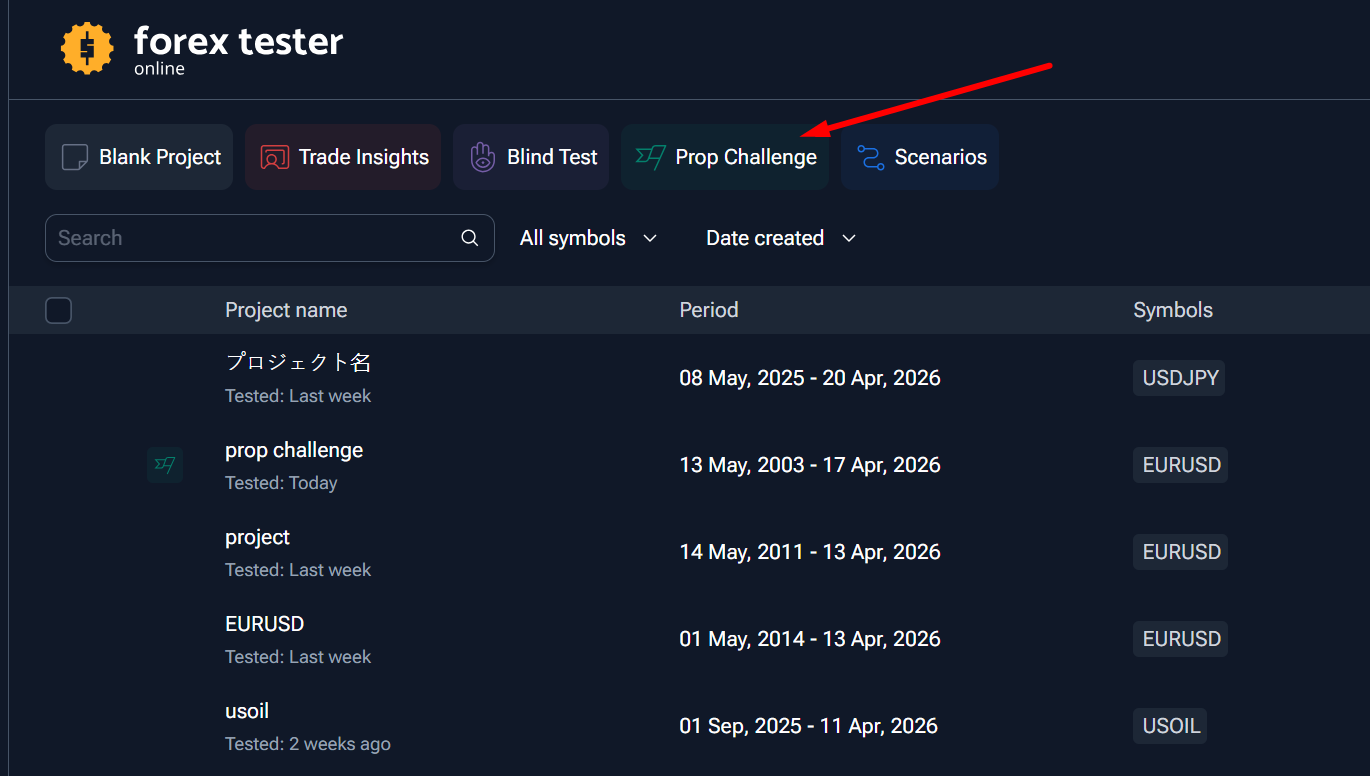
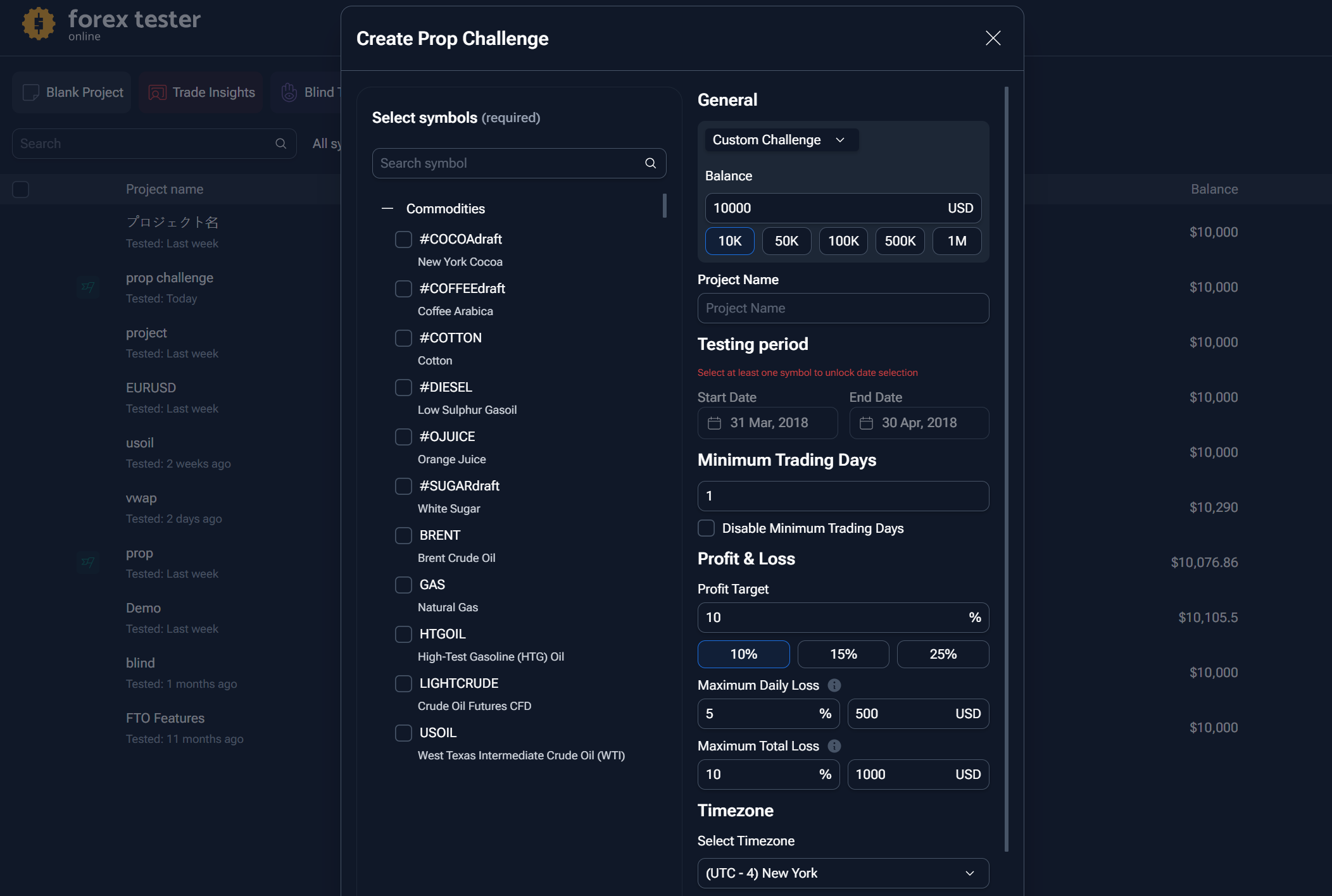
From the dashboard, select Prop Challenge and choose Custom Challenge to enter the exact parameters of your target firm: account size (e.g., $100,000), profit target %, maximum daily loss %, maximum total loss %, and leverage. Getting leverage right at this stage matters — a crypto program at 1:5 and a forex program at 1:30 require completely different position sizing, and practicing with the wrong leverage defeats the purpose of the simulation.
Once configured, Forex Tester Online will terminate the simulation automatically when any limit is breached — exactly as a real evaluation does. This is the critical mechanism: you’re not watching the numbers yourself and deciding whether to stop. The platform enforces the rules without emotion, which is what the actual evaluation does.
Name the project after the specific firm and program. Running the same configuration on three different historical date ranges before concluding anything is a minimum — one pass or fail is not statistically meaningful. Each project has its own separate analytics, so treat each run as an independent data point.
Step 3 — Workspace Configuration (Spreads, Commissions & Multi-Chart)
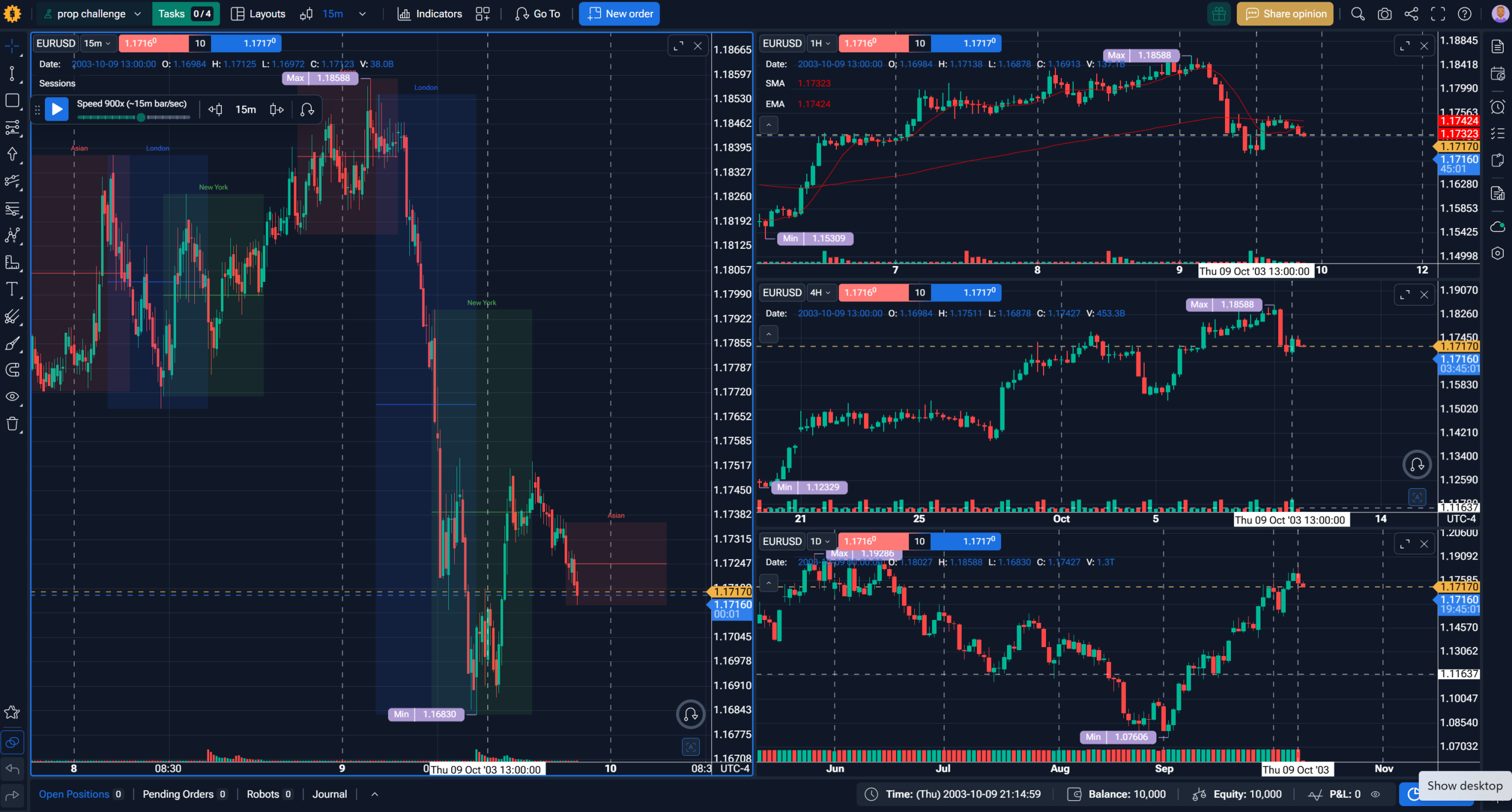
With the challenge parameters set, configure the trading environment to match your target firm’s actual conditions as closely as possible. Set the spread and commission to reflect the firm’s execution costs — this affects every trade’s P&L and therefore how fast you approach the profit target and the drawdown limits. Set up the number of charts and timeframes your strategy requires; FTO supports up to 16 synchronized charts simultaneously, so you can replicate the exact multi-timeframe view you’d use in a live session.
The goal of this step is simple: by the time you place the first trade, nothing about the environment should feel different from what you’ll face in the real evaluation.
Step 4 — Analysis and Refinement (Exit Optimizer & Trade Analyzer)
Passing a simulation is one thing. Executing the same way under a live evaluation — where a rule violation means real money and a failed attempt — is another. Most traders who backtest well and then struggle in live challenges aren’t failing because their strategy is wrong. They’re failing because exit decisions made under pressure look nothing like exit decisions made in a relaxed simulation. The moment real consequences enter the picture, discretion creeps in: closing early, moving targets, second-guessing.
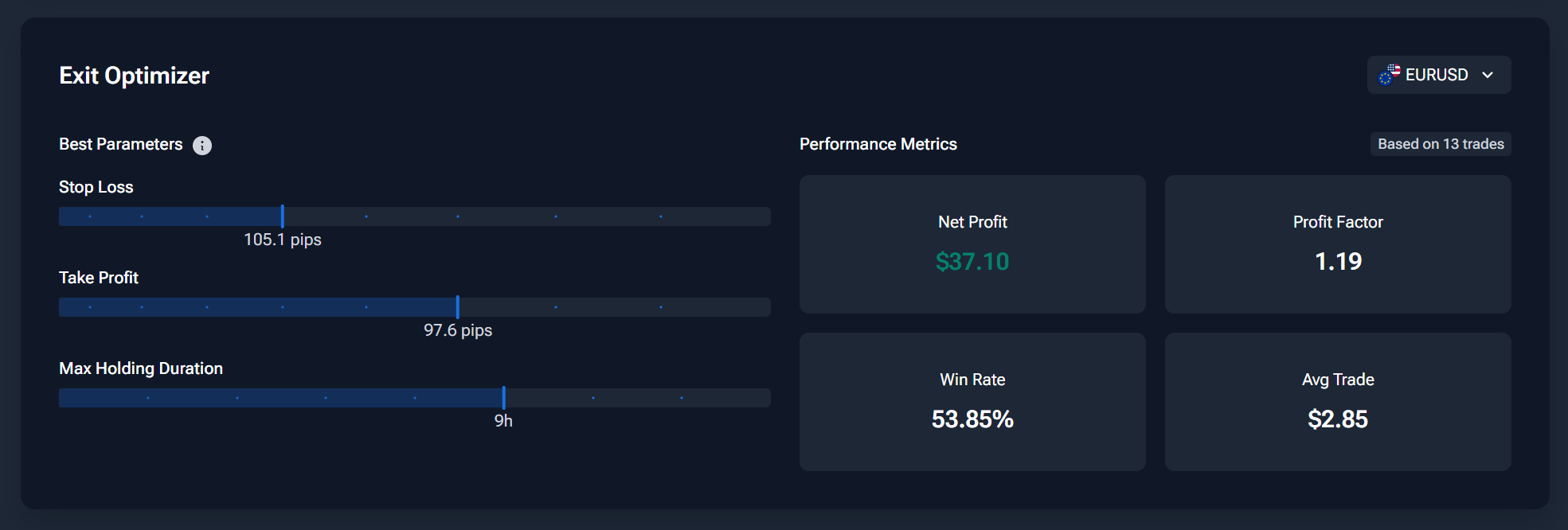
This is where the Exit Optimizer earns its place. It gives you a concrete set of numbers — a specific stop distance, a specific take profit, a maximum hold time — derived from your own trade history. The results appear as interactive sliders: move any parameter and all performance metrics update in real time. When you’re in a live evaluation and the position is moving, you’re no longer deciding. You’re executing parameters you’ve already committed to.
If you prefer pure price action and don’t want a fixed take profit, the Trade Analyzer still helps: it identifies which sessions generate the most drawdown, which days of the week your results deteriorate, which setups underperform. That’s not a rigid ruleset — it’s a way to formalize what you already do intuitively, see it in numbers, and make deliberate decisions about it rather than discovering the patterns through a blown evaluation.
Disclaimer
Trading involves risk. The indicators in this article are for educational purposes only and are not financial advice. Past performance does not guarantee future results. Always test strategies before using real money.
Conclusion: Matching Your Edge to the Right Funder
The best funded trading program is not universally the cheapest, the most lenient, or the most well-known. It’s the one whose rules, drawdown mechanics, and platform environment are best aligned with how your strategy actually behaves in live market conditions.
For forex and CFD approaches, the firms with static drawdown at both evaluation stages and documented payout reliability offer the clearest risk profile. FTMO remains the benchmark for transparency; FundedNext offers higher potential profit splits for traders who can meet consistency requirements.
For futures, trailing drawdown is not a rule of the market — but in practice it’s the convention at virtually every futures program running today. EOD trailing (Topstep, My Funded Futures) is substantially more manageable than intraday trailing for strategies that hold through session volatility. Platform familiarity with NinjaTrader or Tradovate before the evaluation starts matters more than most beginners expect.
For crypto, the lower leverage and 24/7 market hours require a purpose-built risk management approach. Position sizing rules from forex do not transfer directly.
Across all three categories, the gap between traders who pass on the first attempt and those who spend $200–$400 learning the rules through failure is not strategic. It’s preparation — specifically, running enough simulated challenge sessions on tick-level historical data to know exactly how close to the limits your strategy operates before a real evaluation fee is on the line.
That preparation happens in Forex Tester Online.
FAQ
What’s the difference between a 1-step and 2-step prop evaluation?
In a 1-step evaluation, you hit a single profit target (typically 8–10%) while respecting drawdown rules, then move directly to the funded stage. In a 2-step evaluation, Phase 1 requires a higher target (often 10%) and Phase 2 a lower one (4–5%), with the same drawdown limits throughout. Two-step programs generally have lower monthly fees and more lenient daily drawdown limits during Phase 1. One-step programs are faster to complete but often use trailing drawdown and carry stricter funded-stage rules.
What is trailing drawdown and why do most futures programs use it?
Trailing drawdown means your maximum loss limit follows the highest point your equity has reached, not your starting balance. If you grow a $50,000 account to $53,000, your floor moves up to $50,500 (on a $2,500 trailing limit). From that point, giving back $2,600 terminates the account — even though you’re still profitable. Static drawdown, the dominant convention in forex programs, keeps the floor at $47,500 regardless of profits. Trailing isn’t a technical requirement of futures markets — it’s simply the model that nearly every futures-focused firm has adopted, likely because it forces traders to take profits and manage position size more conservatively. The practical takeaway: assume trailing unless a specific futures program states otherwise, and prepare for it accordingly.
Can I use Expert Advisors (EAs) or bots on funded accounts?
It depends on the firm and the program. FTMO allows EAs on most plans but prohibits certain high-frequency patterns and copy trading from external signal providers. FundedNext allows EAs with restrictions on latency-sensitive strategies. Futures programs (Topstep, Apex) do not generally support EAs — they evaluate manual execution only. Always confirm the specific EA policy at the funded stage, not just during evaluation.
How do I practice prop challenge conditions before paying?
Forex Tester Online includes a dedicated Prop Challenge Simulation mode that replicates any firm’s rules — daily loss limits, total drawdown, profit target, and evaluation phase structure — using tick-by-tick historical data. You configure the exact parameters of your target firm, trade as you normally would, and the platform terminates the session automatically if any limit is breached. Running three to five simulated challenges before purchasing a real evaluation is the most direct way to convert a speculative entry fee into a confirmation of something you’ve already done.
Is there a minimum trading experience level required for funded programs?
Formally, no — most programs will sell you an evaluation without any prerequisites. Practically, traders with fewer than 50–100 documented trades in a consistent strategy have a very low pass rate, not because the evaluation is unfair but because they haven’t yet established whether their approach has a reproducible edge. The evaluation reveals that gap quickly and expensively. Testing in a simulator first is cheaper.
What happens to a funded account if I break a rule?
Hard rule violations — exceeding the daily loss limit or total drawdown limit — terminate the account immediately. Most programs offer a reset option at a discounted fee (typically 20–50% of the original evaluation cost), which restores the account to starting conditions. Soft rule violations (failing to meet minimum trading day requirements, inconsistency violations discovered at payout time) typically result in a payout hold or account review rather than immediate termination. The specific consequence depends on the firm’s terms — always read both the evaluation rules and the funded account terms before purchasing.

Forex Tester Online
Simulate prop challenges for free: get ready for your funded account