English
 Deutsch
 Italiano
 Français
 Português
 ไทย
ไทย
 Tiếng Việt
 Polski
 Türkçe
 Nederlands
 Română
 한국어
한국어
 Svenska
 Español
Proprietary trading firms, commonly known as prop firms, offer traders the opportunity to trade using the firm’s capital rather than their own. To ensure they allocate funds to skilled and disciplined traders, these firms often implement “prop firm challenges.”
These challenges serve as evaluation processes where traders must demonstrate their trading acumen, risk management capabilities, and consistency.
What is a Prop Firm Challenge?
A prop firm challenge is a test that traders must pass before getting access to a funded account. The goal is to show that you can make profits while following strict risk rules.
In most cases, you trade on a simulated account with a set starting balance. To pass, you usually need to hit a profit target, stay within daily and overall drawdown limits, and follow the firm’s trading rules.
If you complete the challenge successfully, the prop firm may offer you a funded account. That means you can start trading with the firm’s capital and receive a share of the profits. Many traders want it, but only a few can pass the challenge. It requires trading skills, but also some preparation. One attempt can cost up to $979. Instead, you can use the FTO Prop Firm challenge simulator to practice risk-free.
How Prop Trading Competitions Operate
In these competitions, traders operate with virtual funds over a set period, aiming to meet profit objectives while adhering to strict risk management rules. The evaluation focuses on consistent profitability and effective risk control. Some firms offer free challenges, though these may be highly competitive and provide smaller fund allocations. Conversely, paid challenges often grant higher capital access and additional resources but require an upfront fee.
Advantages of Participating in Prop Firm Challenges
- Access to Capital: Traders can leverage the firm’s funds, enabling them to take larger positions than they could with personal capital.
- Risk Mitigation: Trading with the firm’s money reduces personal financial exposure.
- Skill Enhancement: The structured environment helps traders refine their strategies and discipline.
- Profit Sharing: Successful traders earn a portion of the profits generated, creating a mutually beneficial arrangement.
Common Requirements to Pass a Prop Firm Challenge
To successfully navigate a prop firm trading challenge, traders typically need to:
- Achieve Profit Targets: Reach specific profit goals set by the firm within the evaluation period.
- Adhere to Risk Limits: Avoid exceeding daily or overall drawdown limits.
- Maintain Consistency: Demonstrate steady performance without significant fluctuations.
- Follow Trading Rules: Comply with guidelines regarding trading styles, instruments, and prohibited practices.
Essential Tips for Passing Your Challenge
To increase the likelihood of passing a prop trading challenge, consider the following steps:
- Understand the Rules: Familiarize yourself thoroughly with the firm’s trading rules, profit targets, and risk management parameters.
- Develop a Solid Trading Plan: Create a comprehensive plan outlining your trading strategies, including entry and exit points, position sizing, and risk management techniques.
- Practice Discipline: Stick to your trading plan and avoid impulsive decisions driven by emotions.
- Manage Risk Effectively: Implement strict risk management measures, such as setting stop-loss orders and limiting the percentage of capital risked per trade.
- Maintain Consistency: Aim for steady, consistent profits rather than attempting to achieve large gains quickly.
- Utilize Demo Accounts: Practice your strategies in a simulated environment to build confidence and refine your approach before attempting the challenge.
A prop firm challenge is easier to pass with a reliable trading strategy, and backtesting is the best option for developing a trading strategy and, if necessary, adapting it to certain rules of a prop firm.
Mastering Challenges with Prop Firm Simulator
Forex Tester Online has introduced a game-changing tool for traders looking to succeed in prop firm challenges: the Prop Firm Simulator. This innovative addition allows traders to practice prop challenges without financial risk before attempting official evaluations.
How to Pass a Prop Firm Challenge via Forex Tester Online
The Prop Challenges Simulations feature provides a complete environment for practicing prop firm challenges with realistic conditions. Here is how you can use it step-by-step:
1. Create your Forex Tester Online account
First, open Forex Tester Online and create your account.
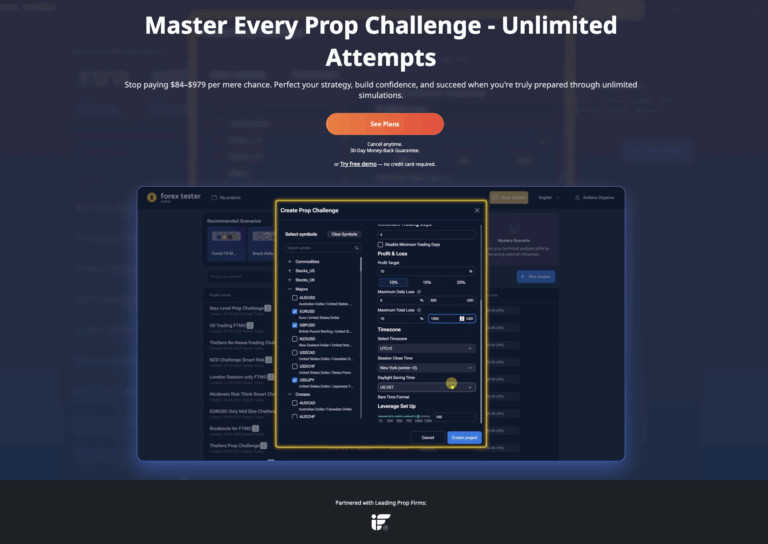
After signing in, go to your dashboard to start setting up your prop challenge simulation.
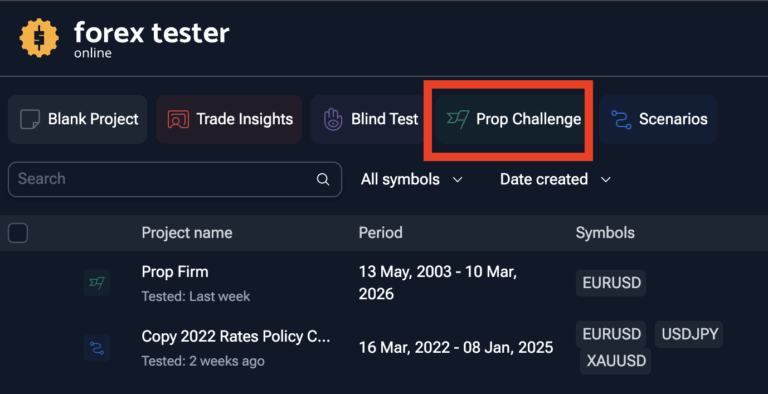
2. Open Prop Firm mode in the main menu
Find the “Prop Challenge” mode section and click to start a new simulation.
3. Adjust rules and settings
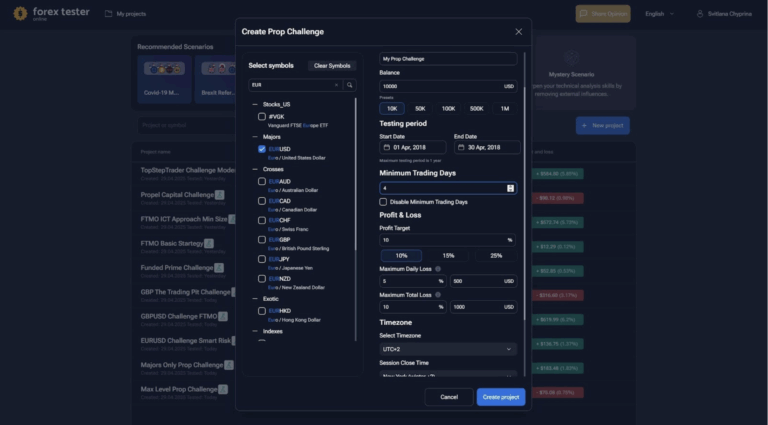
Now enter the parameters of your target prop firm challenge. For example, you can set:
- starting balance
- profit target
- daily drawdown limit
- maximum drawdown limit
- minimum trading days
- allowed asset pool
This helps you create a challenge that matches the real evaluation as closely as possible. You can also save these settings and use them again later.
4. Start the simulation
Once the setup is ready, launch the simulation and begin trading. You can use charts, indicators, drawing tools, and order management features just like in a normal backtesting session.
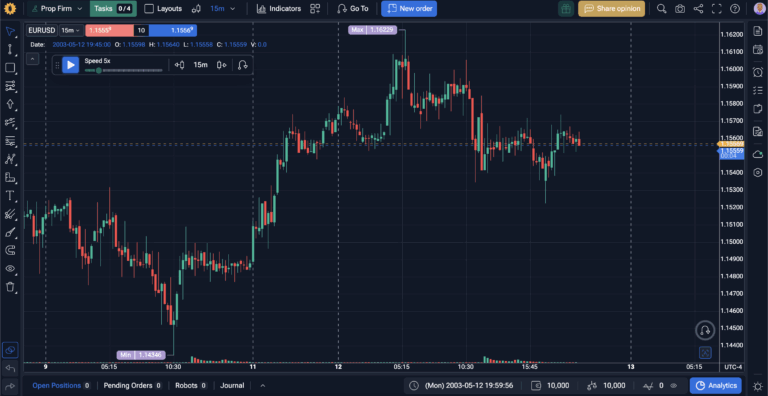
Forex Tester Online also lets you work with accurate historical market data, so your practice is much closer to real trading conditions than basic demo trading.
Unlike paid challenges where failures can be costly, you can run multiple backtests of your strategy with no restrictions, refining your approach until you’re consistently successful.
5. Track your progress during the challenge
As you trade, monitor your results against the challenge rules. Watch your profit target, daily losses, total drawdown, and trading day count.
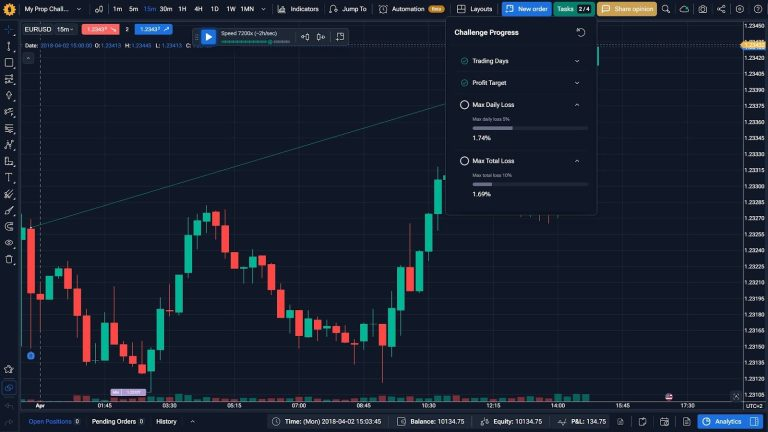
This is important because passing a prop firm challenge is not only about making profits. It is also about staying inside the allowed limits at all times.
6. Use analytics after the run
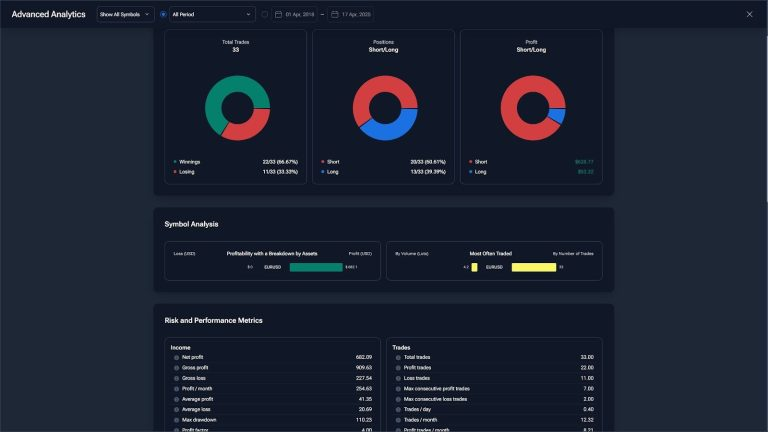
After the simulation ends, open the Analytics section. There you can review detailed trading statistics such as:
- win rate
- average profit and loss
- trade distribution
- results by asset
- drawdown metrics
- trading psychology tips
This data helps you spot weak points in your strategy and see what needs to change before trying again.
7. Repeat as many times as you need
One of the biggest advantages of the Prop Challenges Simulations feature is that you can practice as many times as you need. Unlike real paid challenges, there is no pressure from losing entry fees after every failed attempt.
You can test ideas, fix mistakes, and refine your strategy until you can pass the simulation consistently.
Benefits of Using the Simulation Feature
- Risk-Free Learning: Test your strategies without risking the fees associated with official prop challenges.
- Strategic Refinement: Identify weaknesses in your trading approach and make adjustments in a consequence-free environment.
- Psychological Preparation: Build confidence by experiencing the complete challenge process before attempting the real evaluation.
- Cost Efficiency: Avoid paying repeatedly for failed prop challenges by ensuring your strategy is robust before your official attempt.
- Time Optimization: Focus on developing winning strategies rather than recovering from failed challenges.
With the low success rate of traders passing prop firm challenges (only 5-10% according to industry statistics), preparation is essential. The Prop Challenges Simulations feature provides the ideal training ground to develop the skills, discipline, and strategy needed to succeed in the competitive world of prop trading.
To better understand how to use Forex Tester Online watch this video:
Free vs. Paid Prop Firm Challenges: Weighing the Pros and Cons
Prop firm challenges are an exciting gateway for traders to showcase their skills in real-world trading environments. These challenges often serve as an evaluation tool for firms to identify talented traders who can manage capital effectively. While some firms offer free challenges, others require traders to pay a fee to participate.
Let’s dive into the pros and cons of free and paid prop firm challenges, so you can make a well-informed decision.
Free Prop Firm Challenges
Free challenges can be appealing, especially for traders who want to minimize financial risk while gaining valuable experience. However, they come with certain limitations.
Pros:
- No upfront cost: Free challenges eliminate financial barriers, making them accessible to traders who may not have extra funds to invest.
- Low-risk opportunity: Beginners can test their skills without worrying about losing money.
- Experience-building: These challenges provide a chance to gain exposure and credibility in the trading world.
Cons:
- Scarce availability: Free challenges are often limited in number and highly competitive.
- Lower capital allocation: Even if you pass, the funds allocated for trading tend to be smaller compared to paid programs.
- Minimal support: Resources like mentorship or educational tools are usually limited or unavailable.
Paid Prop Firm Challenges
Paid challenges cater to traders looking for higher stakes and better resources. While they involve an upfront fee, they often come with enhanced benefits.
Pros:
- Wider accessibility: Paid programs are more readily available, offering useful software and high-quality market data (eg specialised paid trading terminals).
- Higher capital allocation: Successful participants typically receive larger amounts of trading capital.
- Additional resources: Many paid challenges include perks like training materials, mentorship, or access to proprietary tools.
- Psychological pressure of real stakes: Paid challenges allow you to try on the psychological pressure of real stakes, i.e. there is a risk of losing money. It is less than if you were trading with your own funds, but it is still there, and it is very useful for beginners.
Cons:
- Upfront financial commitment: The entry fee may deter traders with limited budgets.
- Risk of loss: Failing the challenge means losing your initial investment.
- Stringent criteria: Paid challenges often impose stricter evaluation standards, requiring advanced trading skills.
Common Pitfalls to Avoid
- Overleveraging: Taking positions that are too large relative to the account size can quickly lead to breaching risk limits.
- Deviating from the Trading Plan: Straying from your established strategy increases the likelihood of inconsistent results.
- Ignoring Risk Parameters: Failing to adhere to the firm’s risk guidelines can result in immediate disqualification.
- Chasing Losses: Attempting to recover losses through aggressive trading often exacerbates the situation.
Choosing the Right Prop Firm Challenge
When selecting a challenge, consider factors such as:
- Firm’s Reputation: Research the firm’s track record and reviews from other traders.
- Fee Structure: Understand any upfront costs and evaluate them against potential benefits.
- Evaluation Criteria: Ensure the challenge’s rules align with your trading style and expertise.
- Support and Resources: Some firms offer educational materials and mentorship, which can be beneficial.
These are, in fact, the same criteria we look at when deciding which prop firm challenges to integrate directly into Forex Tester Online as ready-made presets. Fundora, a Japan-based prop trading firm, is one such example — its evaluation rules are transparent and well-documented, which made it possible to replicate the exact challenge conditions, including profit targets, drawdown limits, and risk parameters, inside our simulation environment.
Participating in a prop firm challenge can be a significant step toward a professional trading career. By comprehensively understanding the process, adhering to best practices, and maintaining discipline, traders can enhance their chances of success and gain access to substantial trading capital.
FAQ
How long does it take to pass a prop firm challenge?
The duration to pass a prop firm challenge varies depending on the firm’s specific requirements and the trader’s performance. Some firms offer challenges with set time frames, such as 30 to 90 days, while others may allow unlimited time to meet the objectives. On average, the process can take several months, including both the evaluation and verification stages.
How much do prop firm trading challenges cost?
The cost of participating in a prop firm challenge varies widely depending on the firm and the account size offered. Fees can range from as low as $35 for a $5,000 challenge to over $2,000 for a $500,000 challenge. It’s essential to research and compare different firms to find a challenge that aligns with your budget and trading goals.
How to qualify for a prop firm challenge?
Qualifying for a prop firm challenge typically involves meeting the firm’s eligibility criteria, which may include:
- Age Requirement: Being at least 18 years old.
- Trading Experience: Demonstrating a certain level of trading experience or knowledge.
- Fee Payment: Paying the required challenge fee.
- Agreement to Terms: Agreeing to abide by the firm’s trading rules and conditions.
Specific requirements vary by firm, so it’s important to review each firm’s criteria before applying.
Which prop firm has no challenge fee?
While most prop firms require a fee to participate in their challenges, some firms offer opportunities to get funded without an upfront challenge fee. For example, certain firms may provide free challenges or refund the challenge fee upon successful completion. However, these opportunities may come with more stringent evaluation criteria or lower initial funding amounts.
What percentage of traders pass prop firm challenges?
The success rate for passing prop firm challenges is relatively low. Reports indicate that only about 5% to 10% of traders successfully pass these challenges, and of those who become funded, only approximately 20% receive payouts. This highlights the challenges’ difficulty and the importance of thorough preparation and disciplined trading.

Forex Tester Online
Practice trading to pass prop firm challenges