English
 Deutsch
 Italiano
 Français
 Português
 ไทย
ไทย
 Tiếng Việt
 Polski
 Türkçe
 Nederlands
 Română
 한국어
한국어
 Svenska
 Español
The cheapest prop firm challenge available right now costs $10. You can also fail it three times and have nothing to show for it — which makes it one of the most expensive decisions in trading.
Entry fees have dropped dramatically, but that hasn’t made it easier to get funded. Industry data shows only 7% of prop accounts ever reach a payout. Most traders burn through two, three, sometimes four attempts before passing — not because their strategy is wrong, but because they’ve never tested it against the firm’s specific drawdown rules before paying.
That’s the real cost nobody advertises: not the sticker price, but the sticker price multiplied by how many times you’ll buy it.
Prop challenge simulators exist precisely to solve this — letting you test your strategy against a firm’s exact rules before paying the entry fee. Forex Tester Online is the best option for that preparation. It is covered later in this guide why.
There is another cost that rarely gets discussed: a $10 instant-funding account is a fine way to gamble on a small stake, but skipping the evaluation phase also skips the one thing a simulator alone cannot replicate — the psychological pressure of trading real capital under real rules. That pressure is part of what you are actually paying for when you choose a genuine evaluation over an instant account. Some firms build their entire challenge around this idea, treating the evaluation as a learning experience rather than just a paywall. Fundora, a Japan-based firm not covered in the comparison below, is one such example — the firm puts a strong emphasis on trader education throughout the challenge process, which is also why we were able to build a dedicated preset for it inside Forex Tester Online.
Cheapest Prop Firm Challenges Under $50: Comparison Table
Current verified pricing for $5K and $50K account tiers. Prices shift with promotions — always confirm on firm websites before purchasing.
| Firm | $5K Fee | $50K Fee | Activation Fee | Drawdown Type | Payout Reliability (1–10) |
|---|---|---|---|---|---|
| Blue Guardian | $10 (Instant) / ~$26 (2-Step) | ~$125 (2-Step) | None | Mixed: trailing (1-Step Standard), static (1-Step Pro, 2-Step) | 6 — strong claim of $20M+ paid, but documented delays on futures side; Guardian Shield mechanism generates complaints |
| Maven Trading | $17 (3-Step) / $19 (1-Step) | ~$170 (1-Step) | None | 1-Step: trailing; 2-Step & 3-Step: static | 6 — Trustpilot 4.5/5 from 5,000+ reviews, but wide spreads and 60-pip XAUUSD slippage documented |
| RebelsFunding | €25 (Copper 4-Phase) | ~€150 (Copper 80K tier) | None | Static across all programs | 8 — Trustpilot 4.2/5 from 2,200+ reviews; 200% fee refund on first payout; multiple same-day payout confirmations |
| FundingPips | $29 (2-Step Pro) | $219 (2-Step Pro) | None | Static (eval); trailing (Zero/Instant) | 4 — 50,000+ Trustpilot reviews but BestPropFirms rates 3/10; severe eval-to-funded rule gap; documented payout failures |
| Goat Funded Trader | $17 (2-Step GOAT) | $160 (2-Step GOAT) | None | Static (2-Step); trailing (Instant/Blitz) | 4 — Trustpilot suspended for fake reviews; 27% one-star rate before suspension; $3K daily profit cap on funded accounts |
| FundedNext | $32 (Stellar Lite) | $229 (Stellar Lite) | None | Static (all Stellar evals) | 7 — 63,000+ Trustpilot reviews; $257M+ claimed paid; fake review concerns from Bangladesh IPs; IP/VPS termination pattern |
Note on FundingPips: The “Zero Reward Denial” policy applies to rule-compliant payouts. The documented complaints involve traders who passed evaluations and then had accounts terminated under funded-stage rules that don’t exist during the program itself. This distinction matters.
Top 6 Budget Prop Firms: Lowest Fees for $5K & $50K Challenges
Entry fees alone don’t tell you whether an account is actually passable. The six firms below cover the full price range under $35 — but they’re not equal, and the differences have nothing to do with cost.
Blue Guardian Capital
Blue Guardian’s $10 Instant Starter is genuinely the industry’s lowest entry point for a funded $5K account. There’s no evaluation — you pay $10, you’re funded, you keep 90% of profits up to $250. As a proof-of-concept or first live experience with a prop structure, nothing beats it for price.
The more substantive entry point is the 2-Step program at around $26 with discount codes (regular $49). This uses static drawdown with an 8% maximum — meaning your floor stays fixed at $4,600 regardless of profits. The firm’s headline feature is a 24-hour payout guarantee: miss the window, and the split jumps to 100% on that payment. Blue Guardian claims over $20M distributed across 160+ countries, and most Trustpilot reviews confirm fast payouts on the forex side.
The caveat: Guardian Shield, their auto-close mechanism, has generated recurring complaints. Multiple traders report it triggering while their equity was technically still positive, or timing out near payout submissions. Worth being aware of before you commit.
Best for: traders who want the absolute lowest entry and can accept a smaller account buffer.
Maven Trading

Maven’s $17 3-Step is the most affordable legitimate evaluation in 2026 — not an instant account, an actual skills-based program with static drawdown on the lowest-cost path. The 2-Step at $22 and 1-Step at $19 round out a genuinely competitive lineup.
The 2-Step and 3-Step use static drawdown (8% max, 4% daily), which is the trader-friendly structure. The 1-Step uses trailing drawdown — important to note if you’re looking at the $19 price and assuming the rules are equivalent. They’re not.
Maven’s Trustpilot score of 4.5 from over 5,000 reviews is strong. The main documented issue is execution quality: traders consistently report 4–6 pip spreads on supposedly raw accounts, and at least one verified case of 60-pip slippage on XAUUSD. The profit split is fixed at 80% with no path to higher splits — below what most competitors offer at the funded stage.
Best for: traders who want the lowest cost evaluation with static drawdown and can manage spread sensitivity in their strategy.
RebelsFunding
RebelsFunding’s Copper 4-Phase program is the most structurally sound option at this price point. At €25 for a $5K account — occasionally as low as €6–9 with promotional codes — you get 100% static drawdown: every program they offer uses fixed limits. The Copper account runs a 10% max drawdown from initial balance with a 5% daily cap. Pass all four phases and you’re funded with an 80% split rising to 90% from month two onward.
The reason static drawdown matters for budget accounts is simple arithmetic. Say you grow your $5,000 account to $5,500. With trailing drawdown, your floor has risen — you now have a smaller cushion than when you started. With RebelsFunding’s static structure, your floor is still at $4,500. You have $1,000 of room versus the $500 you started with. The account gets more manageable as you make money, not less.
The firm also offers a 10% reset discount after a blown Copper account and a 200% fee refund after first payout — the highest refund ratio in the budget category. Payout turnaround based on community feedback consistently runs within 24 hours.
Best for: traders who want the most forgiving budget structure and an EU-registered firm with a solid payout track record.
FundingPips

FundingPips is worth including on price alone — $29 for a $5K 2-Step Pro evaluation, $219 for the $50K tier — but it requires the most homework before buying.
The evaluation structure is clean: static drawdown (6% max for Pro, 10% for Standard), no time limits, no consistency rule during the program, 80% profit split standard with an option to purchase 95%. The “Zero Reward Denial” policy is real — no rule-compliant payout has been refused.
The problem is what “rule-compliant” means after you pass. The funded stage introduces consistency rules, news trading windows, instrument-specific lot caps, and on the Zero program, a 1% floating loss cap that functions as an intraday stop-out. A trader who passes the evaluation trading aggressively during NFP can be terminated on the funded account for the exact same behavior. This eval-to-funded gap is documented and specific — not isolated complaints, but a structural difference between the two phases.
If you buy FundingPips, read the funded account rules before buying the program, not after.
Best for: experienced traders who know the funded rules and can trade within them consistently.
Goat Funded Trader

Goat Funded Trader matches Maven at $17 for the $5K 2-Step GOAT and has the most affordable $50K option in this list at $160. Two features are genuine advantages: no time limit on all evaluation models (confirmed, no exceptions except the $1 novelty account), and no consistency rule during evaluation.
The 2-Step GOAT uses static drawdown — 10% max, 5% daily — which is generous for a $17 entry. For swing traders who need weeks to play out a full program, the no-time-limit structure plus static drawdown is legitimately appealing.
The funded-stage picture is more complicated. Goat Guard auto-closes all positions at -2% floating PnL. The first trigger halves your split to 50%; the second ends the account. A $3,000 daily profit cap deducts any excess — severe for anyone trading volatile instruments with position size. And Goat Funded Trader’s Trustpilot profile is currently suspended for fake review violations, with 27% one-star reviews documented before suspension.
None of this makes the evaluation impossible to pass. It does mean the low entry price and the actual funded account experience are less connected than they appear.
Best for: swing traders who specifically need no time pressure, willing to accept higher funded-stage scrutiny.
FundedNext

FundedNext’s Stellar Lite at $32 for $5K and $229 for $50K sits at the top of this price range but brings the highest verified payout volume in the group — $257M+ claimed across 93,000+ traders, with 63,000+ Trustpilot reviews.
One clarification on the much-discussed 15% profit share feature: it does not apply to Stellar Lite. It applies to the Stellar 1-Step and 2-Step programs, and even there it’s calculated on 15% of the profit target amount — not 15% of all profits — and becomes withdrawable only after hitting 10% growth on the funded account. It’s a real incentive but a delayed one.
What Stellar Lite does offer is a clean static drawdown (4% daily, 8% max), no time limit, and a scaling path from 80% to 90% split. The main documented issue is account termination tied to VPS and IP routing near payout time. If you trade on VPS, verify FundedNext’s allowed provider list before funding.
Best for: traders who prioritize reputation and verified payout volume and can manage VPS compliance.
The “Cheap” Trap: 4 Red Flags to Check Before Buying Any Program
Before buying any funded trading program under $50, run through this checklist. These aren’t theoretical risks — each one shows up repeatedly in documented trader complaints.
🚩 The activation fee that appears after you pass. Some firms advertise $20 entry fees but charge a $150 “platform fee” or “funded account setup fee” once you clear the evaluation. If the total cost to access the funded account isn’t clearly disclosed on the pricing page, treat it as a red flag and ask for support before buying.
🚩 Trailing drawdown on a low-cost account. This is the single biggest cost disguised as a feature. On a $5K account with 5% trailing drawdown, your initial floor is at $4,750. If you trade up to $5,200 and then give back $450, your account is terminated — even though you’re $200 in profit from the start. At $5,100 peak, your floor has risen to $4,845. One average losing day can end the account. With static drawdown, none of this applies — your floor stays fixed regardless of profits. The $17 entry with trailing drawdown is harder to pass than the $25 entry with static drawdown.
🚩 The 30% consistency rule. Many budget firms don’t enforce consistency during evaluation — but apply it to funded accounts. The rule typically means no single trade can represent more than 30% of total profits. If you had three losing days and one big winning day, that winner may be flagged. Check whether this rule exists specifically at the funded stage, not just during the program.
🚩 Payout lock-in periods. Low-cost firms routinely require 30 days of funded trading before your first withdrawal. Premium firms offer 7–14 day cycles. The difference isn’t just patience — it’s how quickly you can recycle capital into the next scale-up. If the payout schedule isn’t stated explicitly, assume the worst.
The $200 Mistake: Why the Most Affordable Entry Is Often the Most Expensive
Here’s the math that doesn’t appear in comparison tables. The average trader needs 2–4 attempts to pass their first funded evaluation. At $25 per attempt, four failures cost $100 before a single funded day. At $17, four failures cost $68. Neither number is catastrophic — but both assume failure is random, which it isn’t.
Most failures happen for predictable, preventable reasons. The top three, based on industry data: daily drawdown violations (not understanding how close to the limit you were during normal trading), overleveraging (risking 3–5% per trade when the drawdown math only supports 0.5–1%), and trading through high-impact news on firms that restrict it in the funded phase. None of these require a difficult market — they require familiarity with the firm’s specific math applied to your specific strategy.
That’s what backtesting under prop firm conditions actually solves. Not strategy discovery — you already have your strategy. It’s calibration: understanding exactly how close your normal trading comes to the limits, before you find out during a live program.
How to Use Forex Tester Online to Pass a $25 Evaluation on the First Try
Forex Tester Online is a browser-based backtester and a prop firm challenge simulator built for retail traders. No installation. It runs 23+ years of tick-by-tick historical data across forex, crypto, and futures — including economic calendar events with timestamps, so you can replay exactly what happened during NFP or CPI at any point in the past two decades.
For prop evaluation preparation specifically, FTO offers a dedicated Prop Challenge Simulation mode that mirrors the conditions of real programs. Relevant features for this use case:
- Prop Challenge Simulation mode — set exact daily drawdown % and max drawdown % to match the firm you’re targeting; FTO terminates the session automatically when a limit is breached
- Tick-by-tick data — unlike MT5 backtesting, which generates simulated ticks from bar data, FTO uses real historical tick flow; critical because prop firms calculate drawdown on equity (including unrealized P&L), not balance — mid-candle equity dips that MT5 often misses are exactly what blow real funded accounts
- Economic calendar integration — identify and filter high-impact news events within any test period
- Fast Forward mode — compress a full simulated period of trading into a single session to test discipline over time, not just individual setups
- Adjustable commission and swap — model the execution costs of the specific firm you’re targeting
Step-by-step: how to run a simulation before buying any evaluation
Step 1 — Open FTO and select Prop Challenge. On the projects dashboard, click the “Prop Challenge” tab in the top navigation. Select Custom Challenge to mirror the exact rules of any firm.
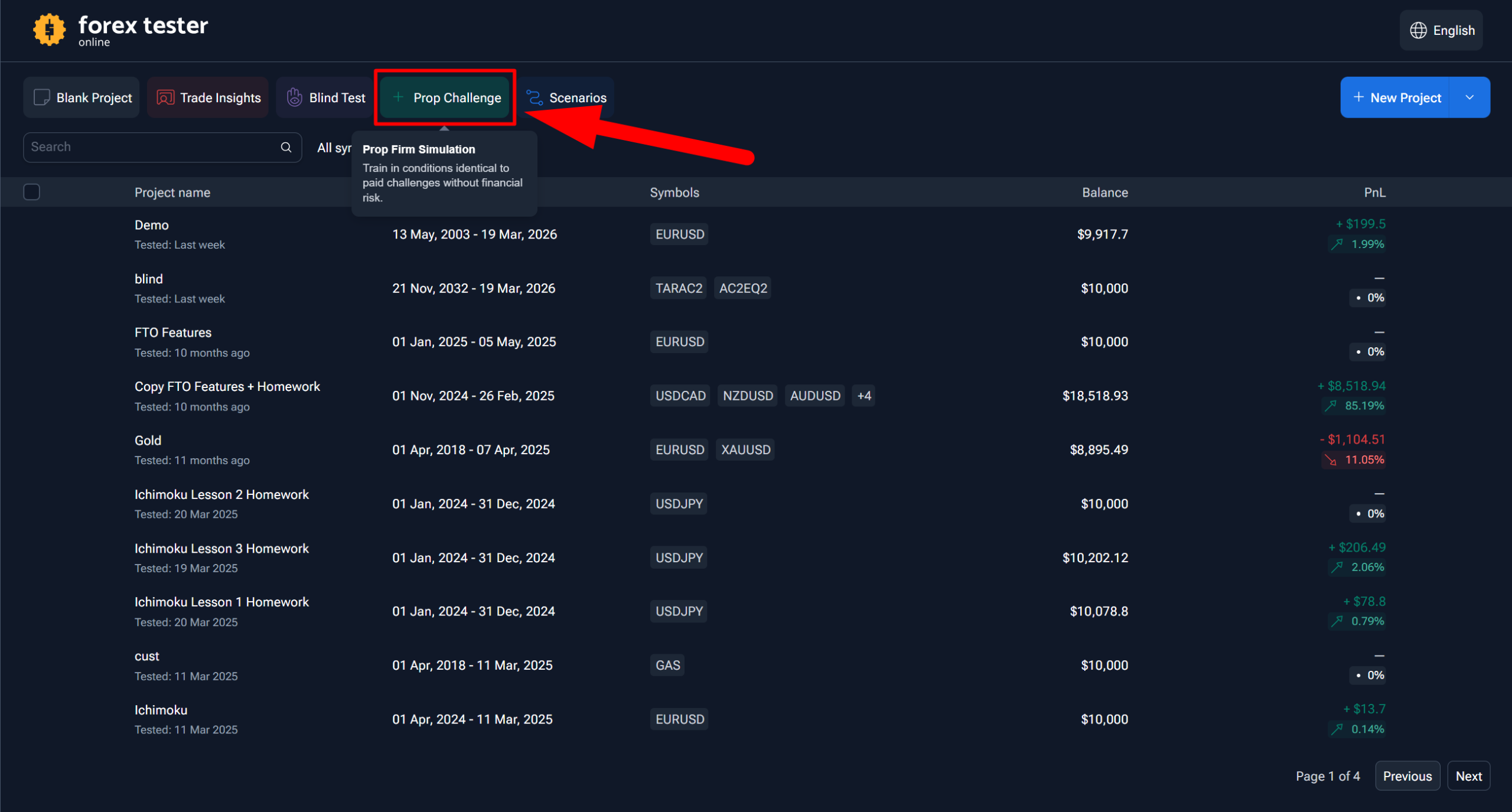
[Screenshot: prop-step-1 — Prop Challenge tab with tooltip]
Step 2 — Configure the rules to match your target firm. The setup screen lets you select instruments, set a testing period, and enter the firm’s specific parameters: Profit Target %, Maximum Daily Loss %, and Maximum Total Loss %. For example, to simulate FundingPips 2-Step Pro: Profit Target 8%, Max Daily Loss 5%, Max Total Loss 10%. Name the project after the firm so you can compare runs later.
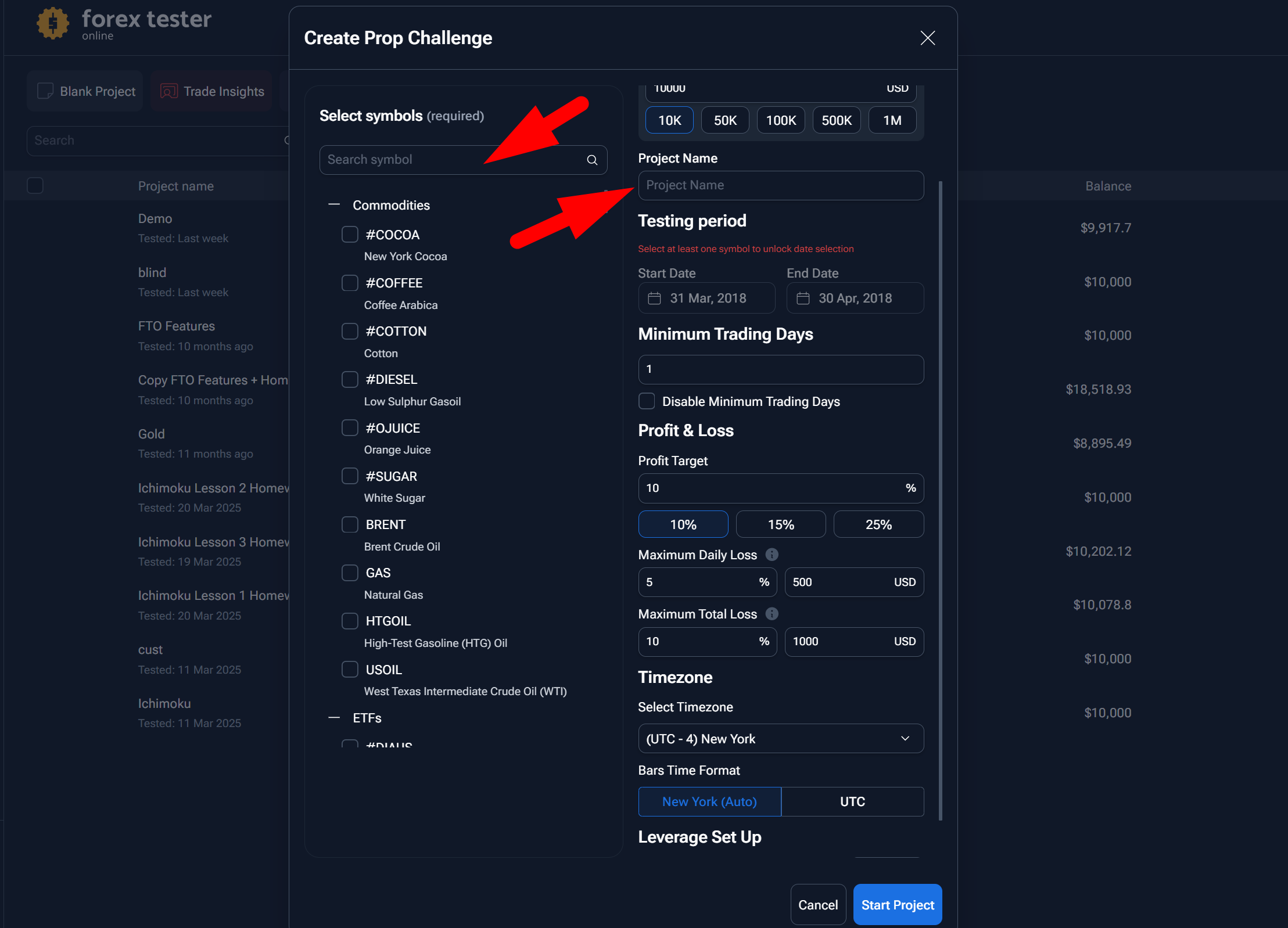
[Screenshot: prop-step-2 — Create Prop Challenge setup screen]
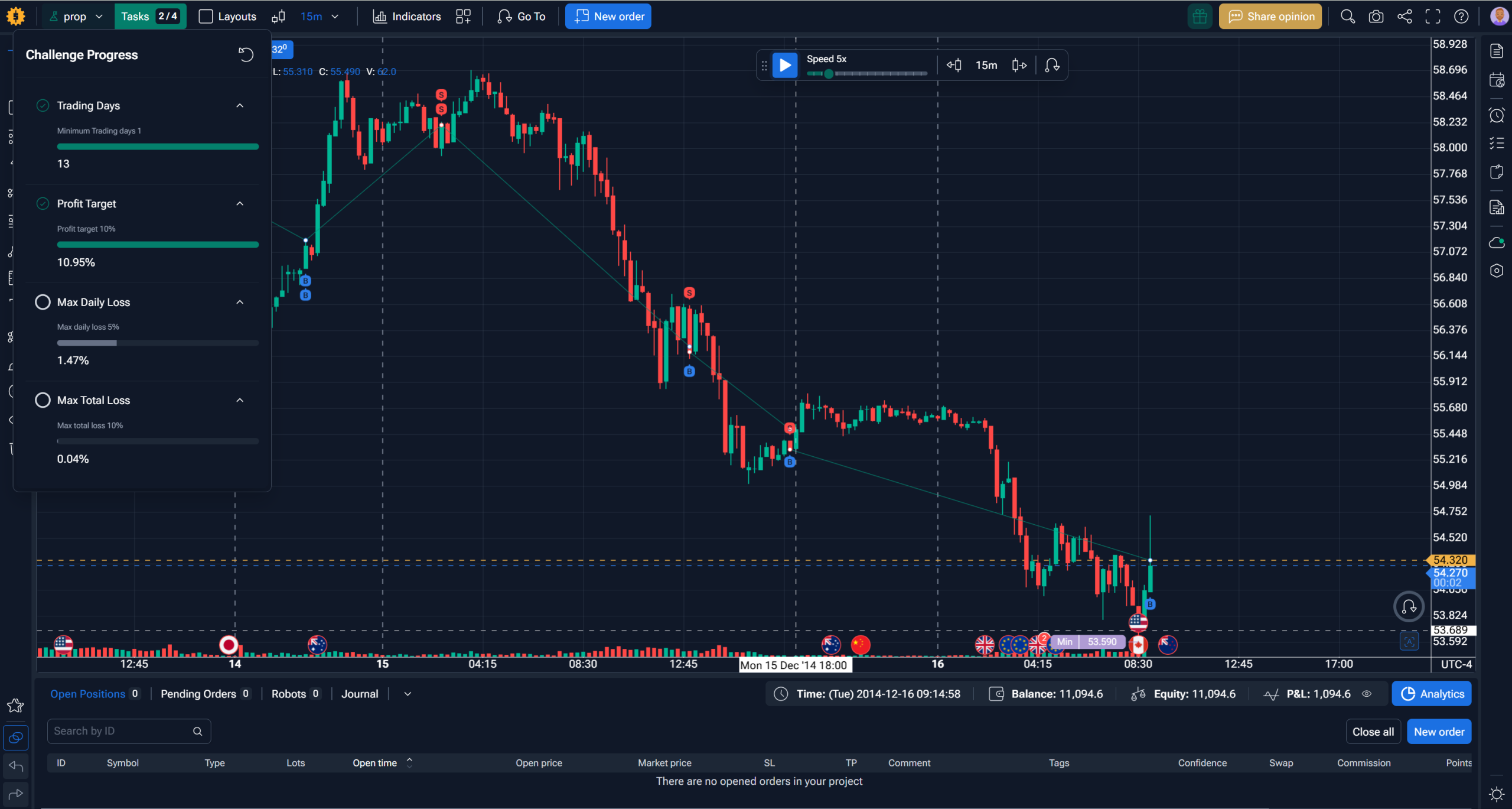
Step 3 — Trade and track your progress. Once the simulation starts, the Challenge Progress panel on the left shows live tracking of all the parameters as you trade. The economic calendar with high-impact events is marked on the timeline. You can see in real time exactly how close you are to each limit. Use Fast Forward mode to compress the session.
[Screenshot: prop-step-3 — Active simulation with Challenge Progress panel]
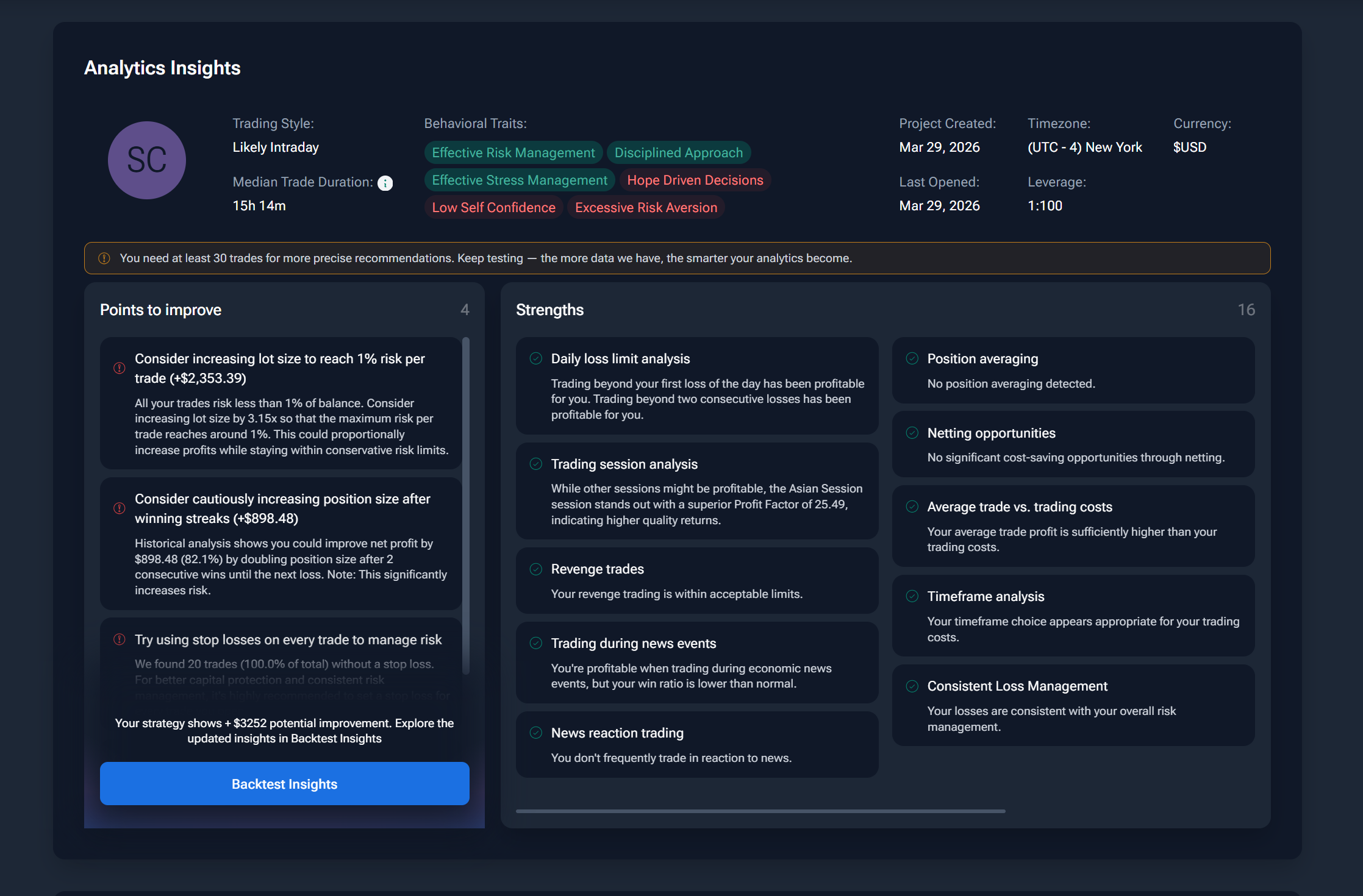
Step 4 — Finish, review, and repeat. When you complete the simulation FTO shows your result. If you passed, click Restart to reset all triggers and run the same challenge on a different date period using Jump To. Review Analytics between runs to see where your equity came closest to the limits. Passing the same conditions twice in a row on different market data means the real entry fee is no longer a gamble — it’s a payment for something you’ve already done twice.
[Screenshot: prop-step-4 — Analytics in Forex Tester Online]
The cost of one month of FTO versus the cost of three failed attempts is not a close comparison. The point isn’t to avoid ever failing — it’s to fail in the simulator rather than in a live account.
Risk Management: How to Protect Your “Thin” Drawdown Cushion
The most common way traders blow low-cost funded accounts has nothing to do with their strategy. It’s position sizing calculated against the wrong number.
Your daily drawdown limit is your actual trading capital — not the account size. On a $5,000 account with a 5% daily limit, you have $250 to lose per day. If you risk 1% of the account per trade ($50), you can lose five times before hitting the daily cap. That’s five average losses away from a failed evaluation — less breathing room than it sounds during a choppy session.
The professional approach: risk 0.25% of total balance per trade ($12.50 on a $5K account). This gives you 20 losing trades before the daily limit, which is enough to survive most bad days without desperate decisions. The math feels conservative until you realize that a 5% daily drawdown limit isn’t generous — it’s a constraint designed to be tight.
Add a personal buffer below the firm’s limit. If the firm allows 5% daily, set your platform’s daily loss alert at 4%. Slippage, commissions, and swap charges have a habit of pushing accounts past the official line without warning. One percentage point of buffer between your personal stop and the firm’s limit is often the difference between a recoverable bad day and a blown account.
News events are a separate risk category. Budget-tier firms frequently struggle with execution quality during NFP, CPI, and central bank announcements. Spreads widen, fills worsen, and equity can breach daily limits in seconds during initial volatility. Rather than trading the spike, focus on the 30–60 minutes after — when price action normalizes but directional moves are still in play. FTO’s tick data lets you practice this specific window on historical events before putting real money at risk.
Static drawdown compounds your advantage as the account grows. If you’re trading a RebelsFunding Copper account or Goat Funded Trader’s 2-Step GOAT, both of which use static drawdown, understand that your risk management situation improves as you make money. At $5,200 balance with a static $4,500 floor, you have $700 of total cushion — 40% more room than at the start. With trailing drawdown, your floor rises with your equity, keeping you perpetually close to the edge. For tight accounts, that structural difference is more valuable than a $10 fee discount.
Conclusion: The Real Cost of “Cheap” Prop Trading
A $17 entry fee is only cheap if you pass on the first attempt. A $25 fee with static drawdown is a better deal than a $17 fee with trailing drawdown if the structure makes the program 40% more likely to pass. And any evaluation is cheaper than failing it four times without understanding why.
The firms in this list are genuinely budget-friendly options — RebelsFunding’s Copper and Maven’s 3-Step stand out for combining low entry with static drawdown and reasonable payout reputations. FundedNext costs slightly more but brings the highest verified payout volume. Goat Funded Trader offers the most affordable $50K option in the industry if the Trustpilot concerns don’t weigh heavily on your decision.
What separates the traders who pass on the first attempt from those who spend $100 trying isn’t luck or a better strategy. It’s familiarity with the firm’s specific math under real trading conditions. Simulating your strategy under the exact drawdown rules in Forex Tester Online before buying the program is the one preparation step that changes the economics of prop trading from gambling to calibration.
The most affordable path to a funded account is: one month of backtesting under prop conditions, one entry fee, and a pass.
FAQ
What is the cheapest prop firm for beginners?
RebelsFunding’s Copper 4-Phase at €25 is the strongest starting point for beginners: static drawdown makes the rules more forgiving as you progress, the payout reputation is solid, and the fee refund policy means successful traders recoup their costs. Maven’s $17 3-Step is the lowest absolute price for a legitimate evaluation, but read the spread disclosures before committing — execution costs on XAUUSD in particular are documented as high.
For absolute beginners who want funded experience without an evaluation phase, Blue Guardian’s $10 Instant Starter gives you a live funded account for less than the cost of a dinner. The $250 payout cap keeps risk low for both sides.
Are there prop firms with no entry or activation fees?
No reputable firm offering serious capital ($5K+) operates with zero fees indefinitely. However, several reduce the effective cost to zero after passing. Goat Funded Trader runs periodic free competitions awarding funded accounts. Most firms, including RebelsFunding (200% refund) and FundedNext, refund the entry fee after one to four successful payouts — meaning traders who pass and get paid effectively spend nothing. Activation fees as a separate post-evaluation charge don’t apply to any of the six firms reviewed here.
Can I get a prop account for $10?
Yes. Blue Guardian’s $10 Instant Starter provides immediate funded access to a $5K account with a 90% profit split and a 24-hour payout guarantee. No evaluation required. The limitation is a $250 payout cap and the Guardian Shield mechanism, which auto-closes positions at a 1–2% floating drawdown threshold. If you need a higher payout ceiling or a traditional evaluation structure, the next price tier is $17 (Maven 3-Step, Goat Funded Trader 2-Step GOAT).

Forex Tester Online
Risk-free Prop Challenge Simulator