English
 Deutsch
 Italiano
 Français
 Português
 ไทย
ไทย
 Tiếng Việt
 Polski
 Türkçe
 Nederlands
 Română
 한국어
한국어
 Svenska
 Español
You just got the notification. The account is closed. Your funded account — the one you spent weeks preparing for, paid a registration fee to enter, and traded carefully for days — is gone. Maybe you hit the daily loss limit on a volatile news day or held a losing position one candle too long.
Whatever happened, the question burning in your mind right now is: what happens after I lose money on a funded account? What should I do next?
I’ve been there. I’ve also seen many traders struggle with this exact moment. The panic, the shame, the urge to buy a new challenge immediately. In my experience analyzing thousands of screenshots from funded accounts, the blow-up itself is rarely the real problem. The moment you cross the rules every prop firm enforces, a clock starts — and what happens in the 48 hours after that breach usually determines whether you eventually make it, or keep repeating the same cycle on a new challenge with the new trading capital to lose.
This guide gives you the full picture: the immediate consequences, the real mechanics of why accounts fail, the applied psychology of blowing up, and a recovery plan using data rather than gut feel.
The Immediate Aftermath: Is Your Money Gone?
The short answer most people need to hear first: you do not owe the prop firm anything.
The Registration Fee: Is It Refundable After a Loss?
The only real money you paid was the evaluation or registration fee. Typically that is $50–$500 depending on the firm and account size. That fee is non-refundable once the challenge begins. It covered your access to the evaluation environment, not the trading capital itself.
The six-figure account balance you were trading? That was never your money to lose. Most prop firms operate on simulated capital during both the evaluation and funded phases, which means the firm itself doesn’t suffer an actual market loss when your account is breached. You lose the opportunity and the fee you paid. That’s the full financial damage.
Personal Liability: Do You Owe the Prop Firm Money?
No. This is the fear that keeps a lot of traders up at night, and it’s worth stating clearly: there is no personal liability for trading losses on a prop-funded account. The prop trading agreement you signed when you started the challenge explicitly defines the drawdown buffer as the firm’s risk to absorb, not yours.
Negative balance protection is built into the model by design. When your account equity hits the maximum drawdown threshold, the firm’s automated risk system terminates access — you can’t lose beyond the preset limit even if you tried. You won’t receive a bill. You won’t face legal action for normal trading losses. What you do lose is access to the trading capital, any unrealized or uncollected profit splits from that account. You also lose the time you invested.
Understanding the Breach: Why Did the Account Close?
Before you can fix something, you need to understand exactly what broke. “I lost money” is not specific enough. There are two distinct types of account closure in prop trading, and they have different implications for what comes next.
Hard Breach vs. Soft Breach: Knowing the Difference
A hard breach is immediate and non-negotiable. You crossed a hard limit — most commonly the daily loss limit — and the firm’s automated system closed your account in real time, mid-session. No warnings. No appeals. The daily loss limit at most firms is typically 4–5% of the account balance. Cross it once, and the session is over.
A soft breach (also called a rule violation rather than a drawdown breach) happens when you violate trading rules — trading during news restrictions, holding positions over the weekend when prohibited, or using a banned strategy. These may not trigger immediate closure in all firms but result in account review and often termination upon audit.
Understanding which type of breach you experienced matters, because the fix is different. A hard breach from hitting the daily loss limit points to a risk management or exit timing problem. A soft breach from rule violations points to a process or discipline problem.
Daily vs. Maximum Drawdown: The Math Behind the Failure
There are two independent drawdown rules working simultaneously on every funded account:
Daily loss limit (DLL): The maximum you can lose in a single trading day, typically 4–5% of the account. This resets at midnight or end-of-day depending on the firm. It’s the most common cause of account termination — one bad session and you’re out regardless of how well you’ve been trading overall.
Maximum drawdown (MDD): The total cumulative loss allowed from the peak account balance, typically 8–12%. Some firms use a trailing maximum drawdown, which is more dangerous than it sounds: as your balance grows, the liquidation floor rises with it. A trader who ran a $100K account up to $110K with a 10% trailing drawdown now has a liquidation floor at $99K — they’ve actually reduced their effective buffer despite being profitable.
In my experience analyzing funded account failures, the daily loss limit catches traders far more often than the maximum drawdown. One impulsive revenge trade after a small loss, or one position held through a high-impact news release, is all it takes.
5 Common Reasons Why Traders Blow Funded Accounts
This is where the real diagnostic work begins. Losing a funded account almost always comes back to one or more of the following patterns. Each one also has a direct fix inside Forex Tester Online (FTO) — which is worth knowing now, because the recovery plan later in this article maps directly back to these failure modes.
1. Over-Leveraging During High Volatility
Traders who trade standard position sizes during quiet market conditions often unconsciously maintain the same lot sizes during NFP releases, FOMC announcements, or surprise central bank decisions. The same 0.5 lot position that moves 15 pips on a normal Tuesday moves 80 pips in 30 seconds during a high-impact news event. The math is simple. The discipline to reduce size ahead of those events — or avoid them entirely — is not.
This is a problem that awareness alone rarely solves, because the news event arrives and the position is already open. The fix is practice under realistic conditions: FTO displays an economic calendar with high-impact news events directly on the price chart during backtesting, so you train yourself to recognize and respond to those moments before they happen in a live evaluation. When you’ve manually navigated through dozens of NFP releases in simulation — scaling down, staying out, or placing a hard stop before the release — the behavior starts to become automatic.
Alarms set to specific dates and times also help.
2. Lack of Statistical Edge (Trading on Intuition)
Many traders reach the funded phase on streaks of good intuition, then discover that intuition isn’t consistently repeatable under the pressure of the prop-firm challenge rules. If you don’t know your actual win rate, average risk-to-reward ratio, or which instruments and sessions produce your best results, you don’t have a strategy — you have a habit. Habits break under pressure. A statistical edge doesn’t.
FTO’s Analytics module converts your trade history into a performance breakdown that surfaces exactly this information: win rate by session, average wins and losses by instrument, profits distribution by time of day. If an edge exists, it will show up in the data. If it doesn’t, the data will tell you that too — before the prop firm does.
3. Moving Stop Losses Out of Fear
The equity curve tells a painfully consistent story with this one. A trader places a trade with a 20-pip stop. The market moves 15 pips against them. Instead of accepting the controlled loss, they move the stop to 40 pips. The market goes on, reverses — but not before triggering the widened stop. One stop-move like this can consume 40–60% of the daily loss limit in a single trade.
This is precisely the behavioral pattern Exit Optimizer is designed to address. By finding the statistically optimal fixed stop loss across your historical trades, it gives you a mechanical reference point — a number grounded in your own data — that you can commit to before the trade is open, when emotion isn’t yet in the picture.
4. Closing Winners Too Early Near the Limit Threshold
This is the mirror image of holding losers too long, and it’s equally destructive to the equity curve. A trader is near their daily profit target and gets nervous about giving gains back. They close a position at +18 pips that would have run to +45. Over time, this behavior produces a win rate that looks acceptable but a profit factor below 1.0 — meaning the average loss exceeds the average win.
Again, Exit Optimizer’s take profit optimization gives you the data-backed target to hold to. It’s worth saying directly: for many discretionary traders, applying mechanical exits — even if it occasionally means missing extra gains from a “wiser” discretionary decision — produces better overall results than making exit decisions under emotional pressure. It sounds counterintuitive. It isn’t. Exits are where discipline fails most reliably, and removing the decision entirely is a legitimate approach that has worked for many traders who consider themselves primarily discretionary.
5. Revenge Trading After a Bad Session
The psychology cascade is well-documented: a loss triggers emotional pain, emotional pain triggers urgency to “get it back,” urgency produces oversized or unplanned trades, unplanned trades frequently lose, which accelerates the drawdown to breach territory. The daily loss limit that seemed comfortably far away at 9 AM can be hit by 10:30 AM after two revenge trades.
The Psychology of a Blown Account: From Chaos to Clarity
Let’s be honest about something that the trading industry often glosses over: blowing a funded account feels genuinely awful, and not just financially.
Overcoming the Shame of a Failed Challenge
The shame response is almost universal. Traders who don’t hesitate to discuss their strategy analysis become suddenly quiet after a blown account. There’s a feeling of having failed a test in front of an audience. Social media full of people posting their verification screenshots doesn’t help.
What’s worth remembering: nearly 60% of traders at prop firms experience account blowups at some point. The majority of consistently profitable funded traders failed multiple evaluations before figuring out their edge. The breach itself is data, not verdict. The question isn’t whether you failed — it’s whether you failed for a reason you can identify and fix.
Breaking the Cycle of Revenge Trading
The urge to immediately buy a new challenge and “prove” you can do it is one of the strongest and most destructive impulses after a blown account. In my experience, traders who jump directly from a breach into a new evaluation without a structured review period almost always repeat the same failure pattern. The challenge changes. The behavior doesn’t.
Taking 7–14 days away from live evaluation trading is not weakness. It’s the mandatory gap that lets the emotional heat dissipate enough to do useful diagnostic work.
Why Your Brain Prefers Gambling Over Backtesting (And How to Fix It)
Loss aversion is a well-established cognitive bias: the psychological pain of a loss is felt roughly twice as intensely as the pleasure of an equivalent gain. When a funded account closes, the brain is in genuine distress — and distress produces a craving for fast resolution, not careful analysis.
Systematic review feels slow. Opening your trade history feels confrontational. Buying a new challenge feels like action, like forward motion. This is the trap. Your limbic system — the part of the brain that processes threat and pain — is running the show, and it’s optimizing for emotional relief, not trading improvement.
Here’s the thing: you have a neocortex. You can decide, in advance and in a calm state, exactly what you will do after a blown account. Step one. Step two. Step three. Written down, time-bound, specific. And then you follow the plan — not because it feels good in the moment, but because you made the decision when you were thinking clearly, and you’re the kind of trader who honors their own rules.
Just like you plan your trades before the session starts, you plan your recovery before the blow-up happens. The plan exists precisely so that your future emotional self doesn’t have to make good decisions under stress. It’s not weakness to need a system. It’s how Homo sapiens sapiens operates at their best — using deliberate thought to override instinct.
The structural fix is therefore simple, even if it isn’t easy: write your post-failure protocol before you need it, and commit to following it the same way you commit to your risk management rules.
How to Bounce Back: A Step-by-Step Recovery Plan
The steps below are a specific workflow using Forex Tester Online (FTO). To get started, create your account if you don’t have one yet, or log in. FTO runs in the browser — no installation required.
Step 1: Psychological Reset & Post-Mortem Analysis
This isn’t a rule — it’s a suggestion from experience. Consider taking at least a few days away from evaluation trading before touching any software. Use that time to write down — from memory — what you believe caused the breach. Be specific. “Bad luck” is not a cause. “I held a EURUSD short through the NFP release because I was already down 2% and didn’t want to close at a loss” is a cause.
This memory-based account matters because it reveals your subjective narrative of the failure. You’ll compare it to the objective data in the next step — and the gaps between the two are often more instructive than either alone.
Step 2: Import Your Trade History & Run Analytics
First, export your trading history from the platform your prop firm used. FTO supports imports from MT4, MT5, NinjaTrader, and TradingView. Each platform has its own export process — refer to the detailed export instructions for your platform by clicking the according links.
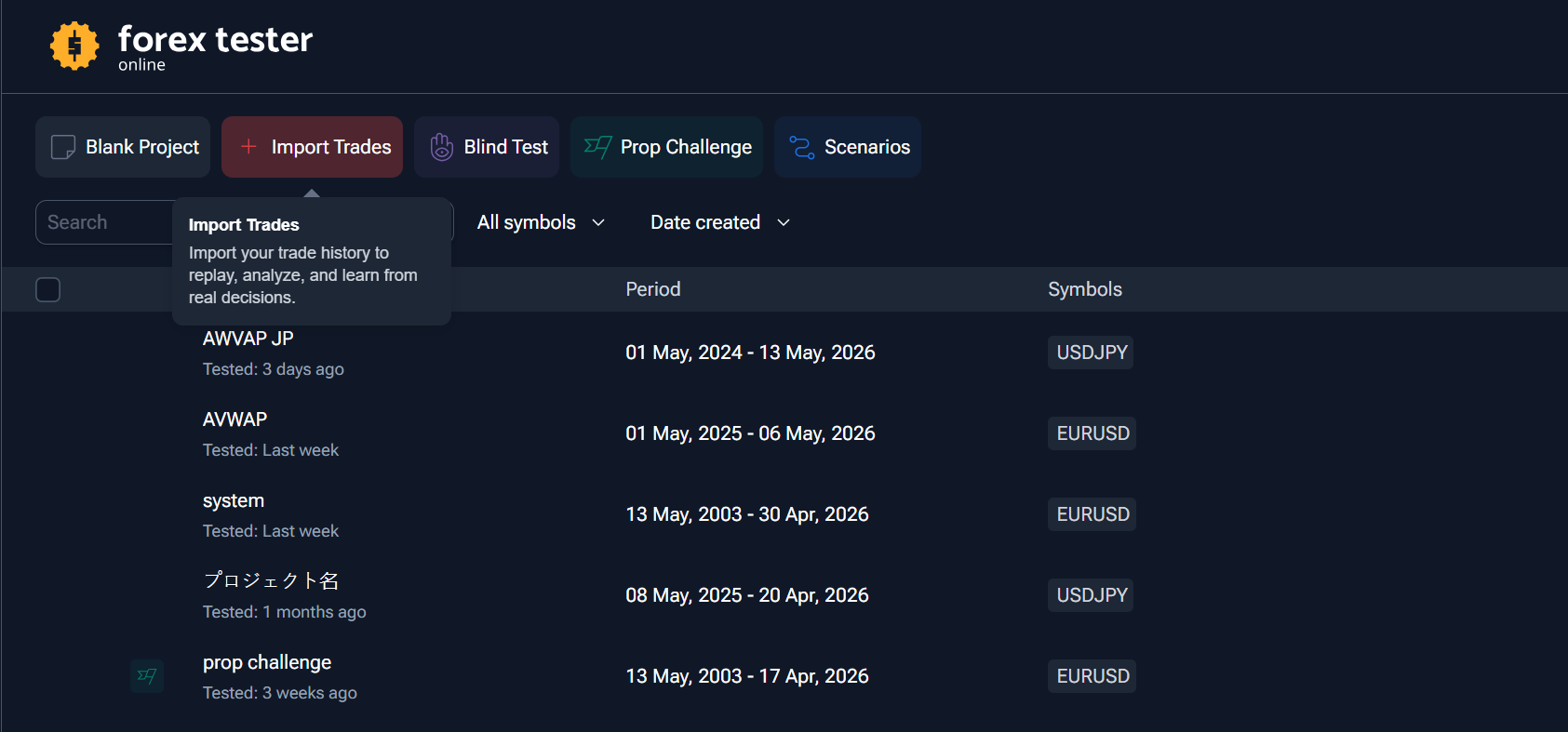
Once you have your export file, open Forex Tester Online, click Import Trade History and upload your file.
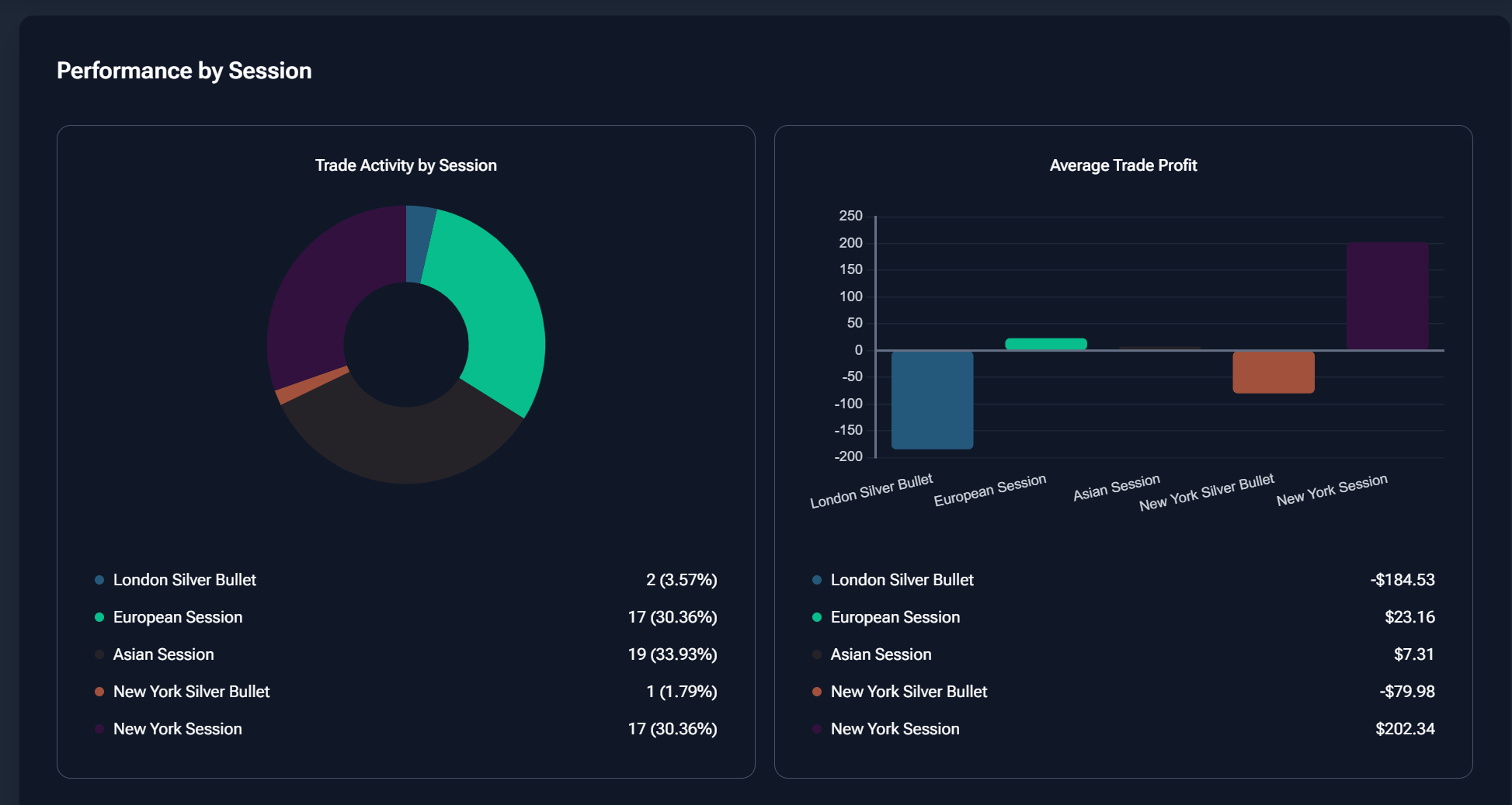
Navigate to Analytics. This is where the real diagnostic work happens. FTO’s Analytics doesn’t just show you a P&L summary — it cross-references your entire trade history against multiple variables simultaneously and proactively surfaces non-obvious weaknesses: which sessions bleed the most drawdown, which instruments are quietly dragging down your overall results, which hours of day your win rate collapses, and where your average loss-to-win ratio breaks down. You may discover that 80% of your drawdown came from trades opened in the first 30 minutes after the London open, or that GBPUSD is systematically unprofitable for your entries while EURUSD holds up fine.
These are not things you can reliably identify by scrolling through trade history manually. The Analytics module processes everything simultaneously and tells you what to look at — including things you wouldn’t have thought to check.
Step 3: Using Exit Optimizer to Fix the Real Problem
In my experience analyzing funded account failures, the most common single cause of breaching the daily loss limit is not the entries — it’s the exits. Holding a loss too long because you don’t want to crystallize it near the daily limit. Closing a winner too early because you’re afraid of giving back gains. Both behaviors slowly drain the equity curve toward the floor.
The important thing to understand: Exit Optimizer works not just on imported live trades, but on trades you take during backtesting sessions in FTO. This is actually where it’s most powerful. Exits are the part of trading where discipline breaks down most reliably — not because traders don’t know their plan, but because the emotional pressure of an open position is real even in simulation. Running backtesting sessions and then analyzing the exits afterward creates a feedback loop that tightens your execution over time.
After a backtesting session (or after importing your live history), again navigate to the Analytics section. Exit Parameter Optimization appears in the panel automatically.
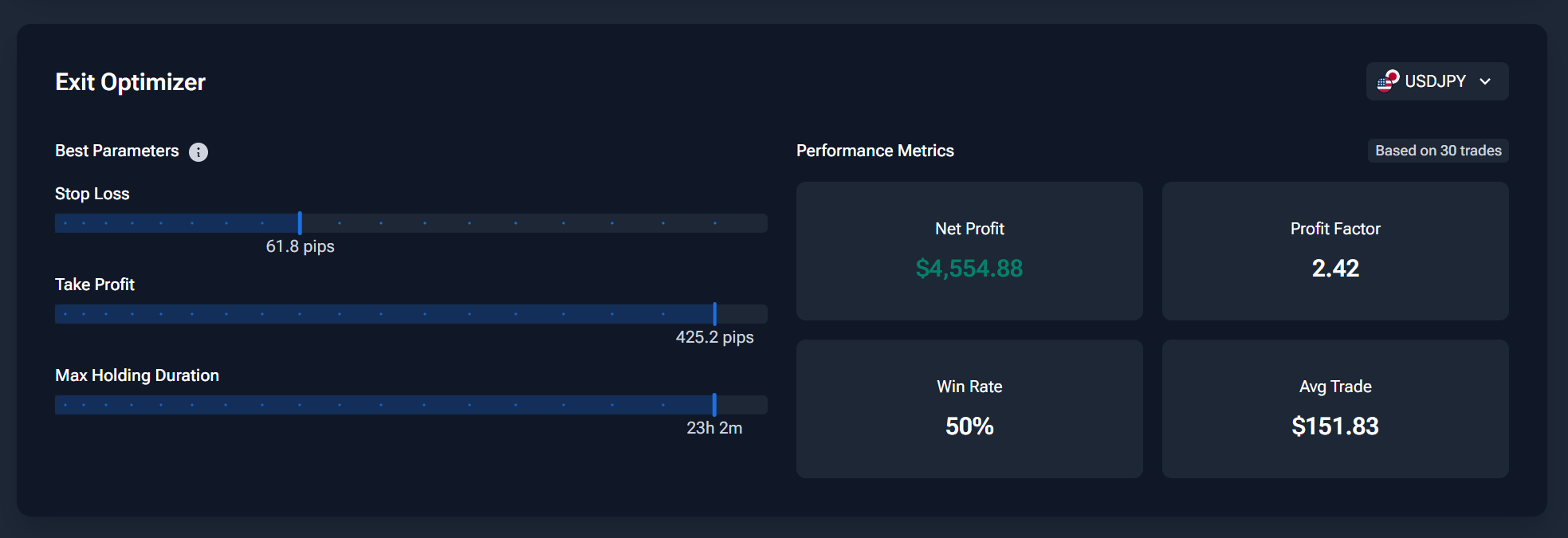
The tool analyzes all trades and finds the optimal combination of stop loss (in pips), take profit (in pips), and maximum hold duration (in minutes) that would have produced the best net profit across your trade history. Results appear as interactive sliders — move any slider to see in real time how different parameters affect your win rate, profit factor, and average trade outcome. The tick mark on each slider shows the statistically optimal value.
What you’re looking at is a data-backed answer to the question you agonized over on every trade: “Should I hold longer or take profit here?” The answer is specific to your entries on your instruments.
One technical note: Exit Optimizer displays values in pips. When entering stop loss or take profit into FTO’s order window, multiply by 10 (the order window uses points). If Exit Optimizer shows 14.9 pips as your optimal stop, enter 149 in the order window.
And to the point made earlier about discretionary vs. mechanical exits: even if the data shows a fixed mechanical stop and take profit do not outperform your discretionary exits, consider committing to those fixed values for the duration of your next challenge. You may miss occasional extra gains. You will likely avoid the catastrophic exits that blow daily limits.
Step 4: Stress-Testing with Prop Challenge Simulation
You now have diagnosed weaknesses and data-backed exit parameters. The next step is proving that your corrected approach actually survives the prop firm’s rule set before you spend money on another live evaluation.
Navigate to the prop challenge simulator inside FTO and configure the exact parameters of the firm where you previously failed: daily loss limit %, maximum drawdown %, profit target %, minimum trading days.
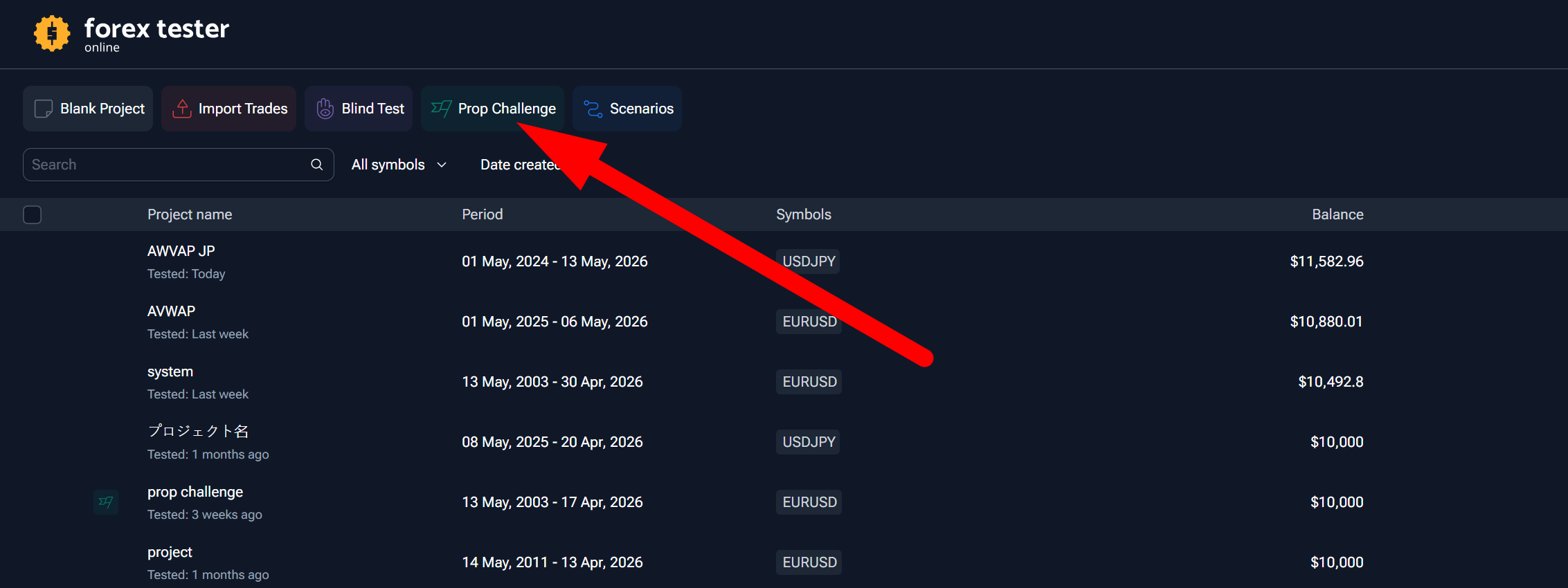
FTO enforces these constraints during the backtesting session in real time — every trade is evaluated against the same rules that closed your funded account. If you hit the daily limit in simulation, the session ends. Same as the real thing.
Backtest your strategy — with the corrected exit parameters from Step 3 — across at least 3 months of historical data. The objective isn’t to prove profitability. It’s to demonstrate that your approach survives the prop firm’s constraints across multiple independent periods without a breach. Run it until you’ve completed the equivalent of the full challenge at least three times without triggering a limit.
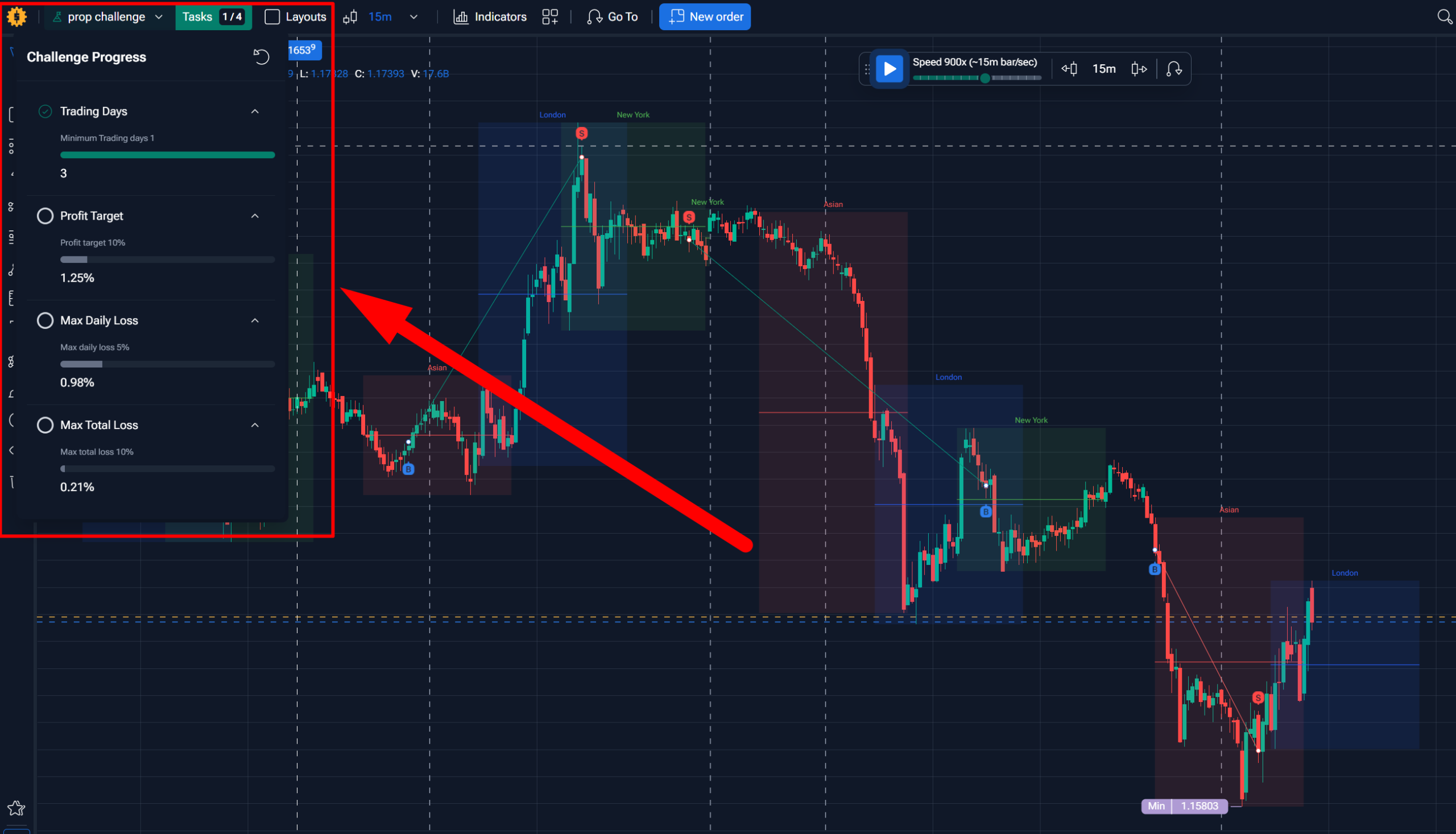
If you breach in simulation, you’ve learned something valuable at zero cost. If you complete it three times cleanly, you’ve built evidence-based confidence rather than hope.
Step 5: Building the Mechanical Skill with Smart Navigation
Use FTO’s Jump To (Smart Navigation) function to target the specific scenarios that caused your original breach and drill them deliberately.
If you blew the account during a high-impact news release, jump directly to historical instances of that event type and practice your response: scaling down position size, placing a hard stop before the release, or simply staying out. If your breach pattern points to a specific session, jump to those moments repeatedly and execute your rules under simulated pressure.
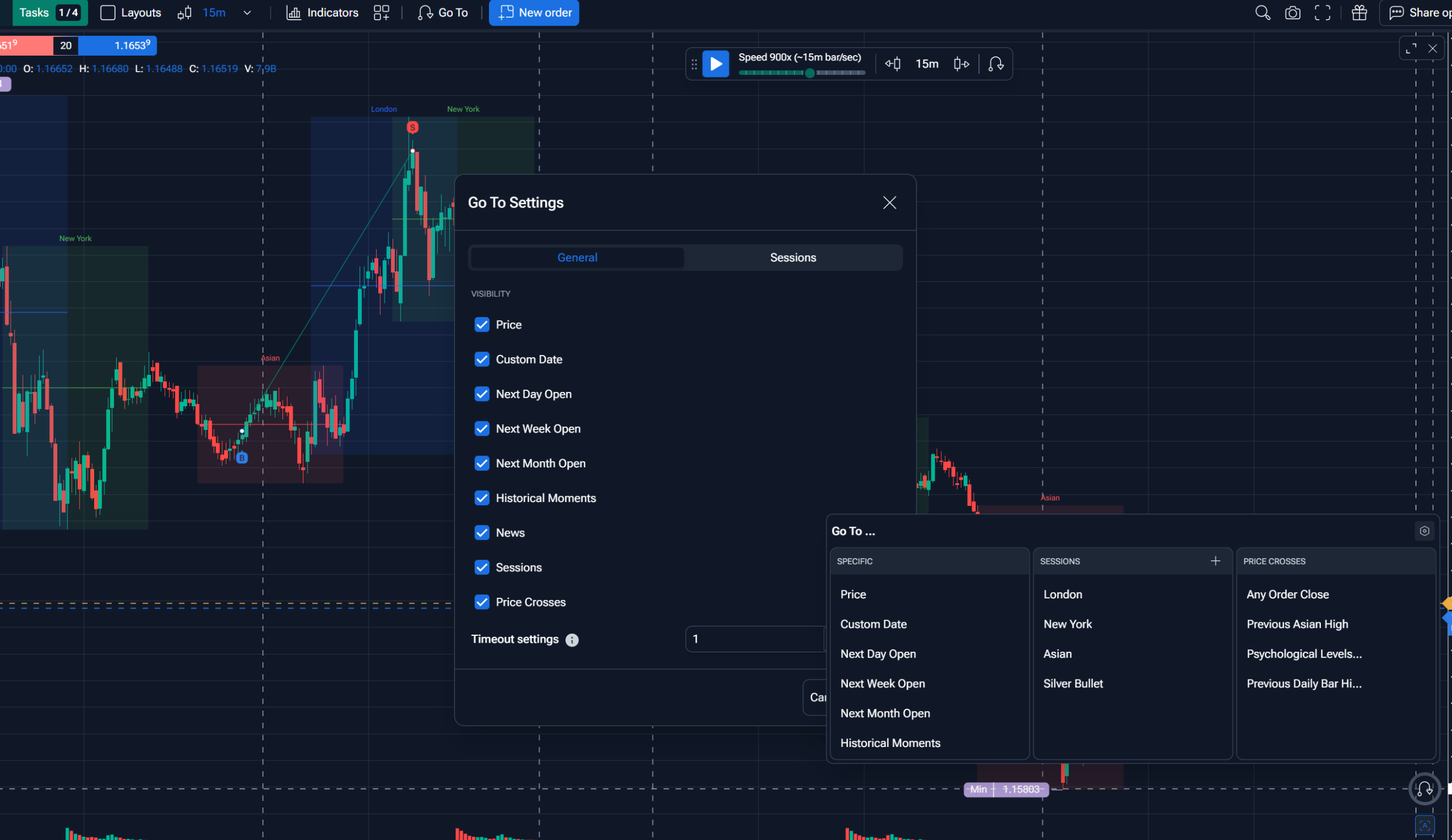
This is the difference between reviewing your strategy and training it. Reviewing is passive. Training is repetition under conditions close enough to real trading that the behavioral habit actually forms.
Don't buy a new challenge until you've passed the equivalent in FTO simulation at least three times.
The challenge fee is $50–$300. The cost of repeating the same failure is your time, confidence, and the compounding opportunity cost of another month without payouts.
The Proactive Solution: Finding the Right Strategy Before the Next Challenge
Recovery isn’t just about fixing the strategy you had. It’s also an opportunity to ask a harder question: was that strategy ever the right fit for prop firm constraints in the first place?
Test Multiple Strategies in Prop Challenge Mode — Before Paying for Any of Them
Not every profitable strategy survives prop firm rules. A scalping approach with a low win rate and high R:R might perform well over three months in free backtesting but consistently breach the daily loss limit during the string of losses that’s statistically inevitable within any two-week evaluation window. A swing strategy that holds positions for days might violate weekend holding restrictions at certain firms. The strategy that made you profitable in your personal account may simply be structurally incompatible with the drawdown constraints of the funded model.
FTO’s prop challenge simulation mode lets you test this before spending money on it. Set up the exact parameters of your target firm — daily limit, maximum drawdown, profit target, minimum days — and run each strategy candidate through at least 3 months of historical data. Not just once. Multiple times, across different market conditions. A strategy that passes in a trending 2023 market may blow up in the choppy ranging conditions of a different period. Run each candidate across both.
What you’re looking for is not just profitability, but compatibility: which strategy produces the best results while staying consistently within the firm’s constraints across varied conditions. That’s the strategy worth buying a challenge fee for. Everything else is a hypothesis that simulation will either confirm or disprove — at no cost to you.
This is the compounding advantage of systematic preparation: every simulation run teaches you something. Every breach in backtesting is a lesson that costs nothing. The goal is to make all your expensive mistakes in the simulator and show up to the real evaluation with a strategy that has already been stress-tested against the exact conditions it will face.
Disclaimer
Trading involves risk. The indicators and tools discussed in this article are for educational purposes only and are not financial advice. Past performance does not guarantee future results. Always test strategies before using real money.
Frequently Asked Questions
Can I buy a new challenge immediately after blowing a funded account?
Technically, yes — most prop firms allow you to purchase a new evaluation immediately. Whether you should is a different question. If you haven’t identified what caused the breach and made a specific structural change to your approach, buying a new challenge is paying for the same lesson twice. Use the recovery workflow above first. Most firms also offer discounted resets or challenge rebates for specific breach conditions — check your firm’s policy before assuming you need to pay full price.
What happens to my earned profits if I blow the account?
Any profits that were not yet withdrawn at the time of the breach are typically forfeited when the account closes. This is one of the practical arguments for requesting payouts as soon as you’re eligible, rather than waiting to accumulate a larger amount. The profit split you earned but didn’t withdraw before the breach is gone — another cost that doesn’t show up in the evaluation fee but is very real.
Does blowing a funded account affect my ability to get funded elsewhere?
Generally no — there is no cross-firm blacklist for normal drawdown breaches. You can apply to any other firm immediately. The exception is if you were banned for rule violations (account manipulation, prohibited strategies, chargebacks on fees), which some firms do share or publicize. Normal trading losses resulting in a breach have no impact on your ability to be funded by a different firm.
How many times can I retry the challenge?
Most firms have no formal limit on the number of times you can attempt an evaluation. Some offer free resets after a certain waiting period (typically 30 days), and others allow immediate resets for a fee. A few firms have introduced unlimited retry models at a fixed monthly subscription. The practical limit is self-imposed: attempting repeatedly without changing your approach is the definition of the failure cycle this article is designed to help you break.

Forex Tester Online
Master Funded Trading with our Prop Challenge Simulator