English
 Deutsch
 Italiano
 Français
 Português
 ไทย
ไทย
 Tiếng Việt
 Polski
 Türkçe
 Nederlands
 Română
 한국어
한국어
 Svenska
 Español
Most traders who look into funded trading have the same starting point: a strategy that works on a demo account and a balance too small to make it count. Prop firms put up the funds, you trade under their rules, and you split the profits. Simple enough on paper.
What’s less obvious is what “their rules” actually means in practice — the specific numbers, the mechanics of how drawdown is tracked, the difference between soft and hard violations. That’s what consistently separates traders who pass a funded account challenge from those who pay for it three times while figuring it out. Managing those rules before you pay for an evaluation is the whole game.
This guide covers how to get a funded account from the ground up: what the evaluation process demands, what the numbers actually look like at the $5K and $50K level, and how to prepare in a way that doesn’t use real capital to prove your ability.
Funded Account Trading Meaning: The Basics
Before getting into the mechanics, it helps to understand what kind of arrangement this actually is and where most explanations stop short.
How do funded trading accounts work?
A funded trading account is an arrangement where a proprietary trading firm allocates capital — most often simulated, occasionally live — to a trader who has passed an evaluation. The trader keeps the majority of any profits — typically 70–90% — while the firm sets strict risk management rules that govern every session. Breach those rules and the account terminates, regardless of overall performance.
That last sentence is the part most people skim over in the excitement of seeing “$100,000 funded account” in a headline. The rules are the product. Understanding them is what separates traders who get funded and stay funded from those who cycle through challenge fees until the cost becomes unsustainable.
Simulated Model
Most major retail prop firms — FundingPips, FTMO, MyFundedFutures, Apex, and most of their peers — operate on a simulated model. Even after you pass the evaluation and receive a “funded account,” the account you’re trading is still a demo environment that mirrors live market conditions: real tick data, real spreads, real price action, but paper capital underneath. Your payouts are real — drawn from the firm’s own balance — but the firm is not routing your individual trades to a live exchange.
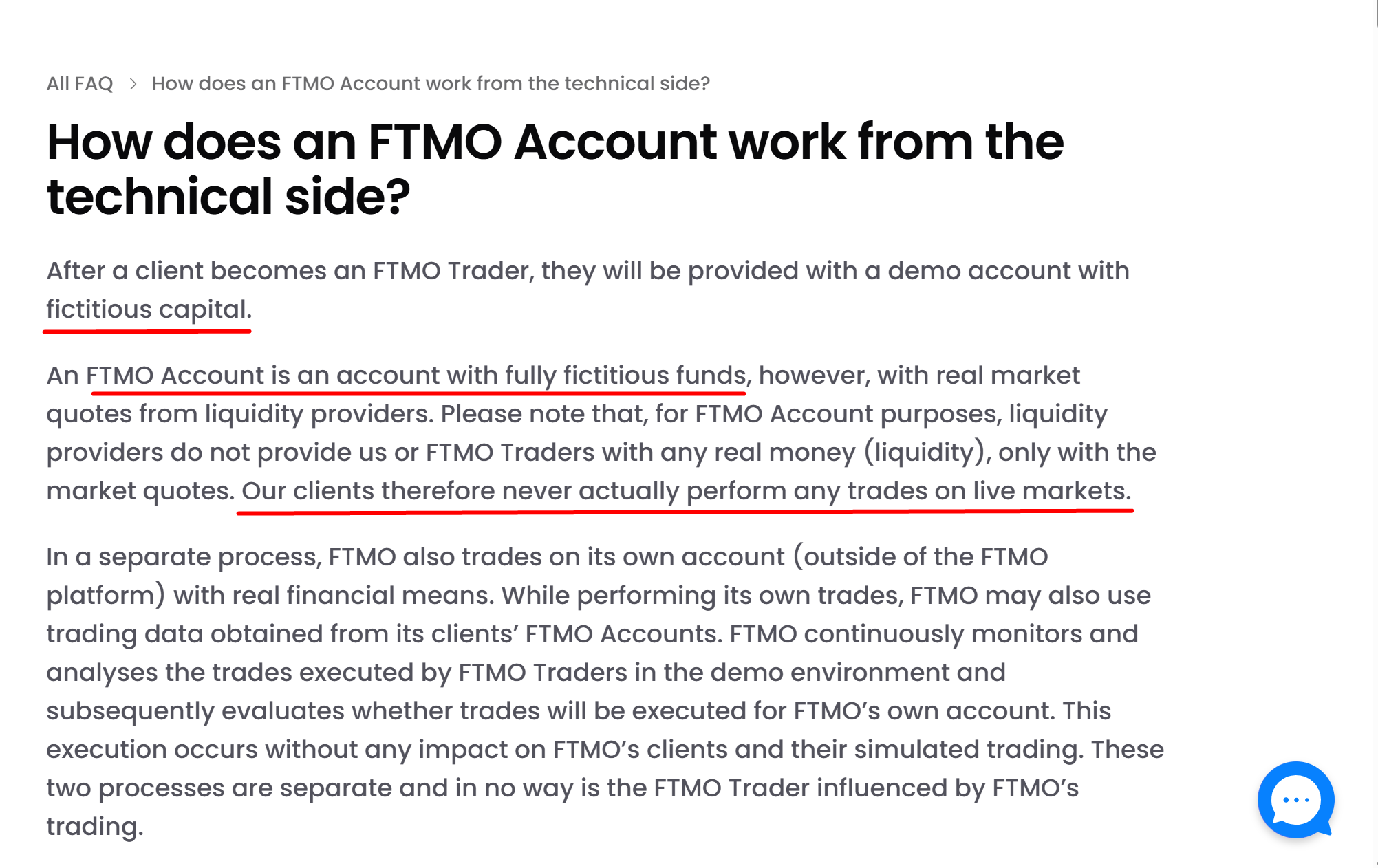
This is not a deception. It’s a regulatory reality. A firm that handed real money to thousands of retail traders and collected entry fees would likely require licensing as a broker or asset manager in most jurisdictions. The simulated model lets prop firms operate without that regulatory overhead. When Maven Trading or FundingPips explicitly write the word “simulated” in their terms, they’re covering themselves legally — not admitting to fraud.
Live-Funded Model
A smaller category operates on a live-funded model, where traders eventually move to accounts connected to real market execution. Topstep is the most prominent example: their final tier (Live Funded Account) routes actual orders through a registered broker. Some traditional prop firms that hire traders directly — the kind with office desks and P&L seats — also work with real capital from day one.
The live-funded model comes with two practical consequences that simulated accounts don’t. First, the trader is typically classified as a professional market participant rather than a retail client — a designation that affects regulatory protections available to you. Second, professional status triggers exchange data fees: market data that retail traders receive cheaply (or free) through their broker is billed at professional rates by the exchanges, which can add $100–$300+ per month depending on the instruments traded. These costs are sometimes covered by the prop firm, sometimes passed to the trader — confirm before committing.
When evaluating any firm, confirm which model applies before signing up. The practical trading experience is nearly identical; the distinction matters for regulatory protection, monthly costs, and what happens to your balance if the firm encounters financial difficulties.
Proprietary vs. Retail Trading
The core difference is who carries the downside risk.
- In retail trading, every loss comes from your personal balance. The broker collects spreads regardless of your outcome.
- In a funded prop model, the firm is theoretically exposed to your drawdown — which is precisely why evaluation challenges exist. They’re a screening mechanism, not a bureaucratic hurdle. Prop firms need evidence that you won’t blow capital that isn’t yours.
This also explains why most prop firms are not regulated brokers. Their role is capital allocation; execution runs through a third-party platform under its own licensing. If regulatory status matters for your situation, verify the execution environment separately from the prop firm itself.
The benefits of trading with a funded account
The most immediate benefit is access to larger position sizing without equivalent personal capital at risk. But this needs an honest framing that most prop firm marketing skips.
When a firm advertises a “$50,000 funded account,” that figure is your position sizing base — the number used to calculate lot sizes and exposure. It is not the amount of firm capital genuinely at risk on your behalf. With a 10% maximum drawdown rule, the firm’s actual exposure is $5,000. That is the real cushion you’re operating with. The $50,000 matters because it determines how large your positions can be and therefore how much you can earn on a winning trade — but your effective “runway” before termination is the drawdown allowance, not the headline number.
The evaluation fee also needs an honest reading. It’s tempting to treat it as a fixed, one-time cost — but that’s only true if you pass on the first attempt. Industry data suggests the average trader needs 2–4 attempts before passing their first funded evaluation. At $150 per attempt, four failures cost $600 before a single funded trading day. The real cost of a funded account is the entry fee multiplied by the number of attempts it takes you to pass.
This is precisely why preparation under the firm’s exact rules — before paying — changes the economics entirely. A prop firm simulator that lets you run unlimited attempts under real drawdown conditions costs a fraction of a single failed evaluation. The traders who pass on the first attempt are rarely more talented than those who fail three times. They’re more familiar with the specific math of the program they bought.
| Trading Your Own $1,000 | Trading a $50,000 Funded Account | |
|---|---|---|
| Capital at risk | $1,000 (personal savings) | Entry fee × number of attempts |
| 2% monthly return | $20 | $1,000 (your ~80% share: $800) |
| 10% monthly return | $100 | $5,000 (your ~80% share: $4,000) |
| Worst-case personal loss | Full $1,000 | Entry fee × attempts (often $300–$600 in practice) |
| Effective drawdown cushion | Your full balance | 5–10% of nominal size ($2,500–$5,000) |
| Scaling potential | Limited to personal savings | Up to $1M–$2M+ via scaling programs |
The position sizing advantage is real and meaningful — but only for a trader who reaches the funded stage. Getting there efficiently is its own problem, and the solution to that problem is practicing under the firm’s specific rule set before committing real money. That’s what the step-by-step section below covers.
What is a Funded Trader? (And is it right for you?)
A funded trader is someone who has passed a prop firm’s evaluation process and is now trading the firm’s capital — simulated or live, depending on the firm — under a formal profit-sharing arrangement. Unlike a salaried trader at a bank, a prop-funded trader is typically classified as an independent contractor — which has implications for how income is reported and taxed that vary by jurisdiction and are worth confirming before you receive your first payout.
The profile of someone who genuinely benefits from this model is specific. You already have a documented, repeatable strategy with a positive expectancy. You understand risk management at the mechanical level — position sizing, stop placement, daily exposure limits. And you have enough psychological resilience to trade within tight parameters without deviating when the market tests your conviction.
If any of those three are absent, funded trading becomes an expensive way to discover the gap — for the exact reasons already covered above: failed attempts add up fast, and the rule set that kills most accounts is learnable before you pay for it.
The pass-rate data supports this soberly. Industry estimates consistently place the proportion of prop accounts that ever reach a payout at around 7%. Topstep, one of the most transparent firms in the industry, publicly discloses that only 16.8% of traders pass their initial evaluation — and fewer than 1% reach their highest-level funded account. These numbers don’t mean funded trading isn’t worth pursuing. They mean preparation is the differentiating variable, not luck or strategy quality alone.
Pro Tip:
Research consistently shows that over 90% of prop challenge failures stem not from a flawed strategy, but from never having tested that strategy against the specific drawdown mechanics of a real evaluation. Trading on a general demo account doesn’t replicate a 5% daily loss ceiling calculated on floating equity. A purpose-built prop challenge simulator does — and using one before paying your first entry fee is the single preparation step with the highest measurable return.
How to Get a Funded Trading Account: A Step-by-Step Path
Step 1: Choosing a Funded Trading Prop Firm
The landscape of prop firms has expanded rapidly and unevenly. Entry fees have dropped — legitimate evaluations are now available under $30 for $5K account tiers — but the industry has also seen firm collapses, fake review campaigns, and payout disputes that cost traders real money.
Before committing to any program, verify these five parameters:
Drawdown structure — static or trailing
Static drawdown means your loss floor is fixed at the initial account balance (a $50,000 account has a $45,000 floor regardless of profits made). Trailing drawdown means the floor rises as your equity grows, making the account progressively harder to hold the more successful you become. For most trading styles, static drawdown is significantly more forgiving — and worth paying a small premium for.
Total cost of ownership, not just the entry fee
Some firms advertise a $20 evaluation fee but charge a separate “funded account activation fee” of $150+ after you pass. Others charge monthly platform fees that begin at the funded stage. Know the full cost before you commit.
Profit split and payout schedule
The industry standard is 80–90% to the trader. Payout frequency ranges from weekly to monthly depending on the firm and the split tier you select. Some firms trade a lower split for faster withdrawals — a useful option if cash flow matters.
Rule differences between the evaluation and the funded stage
This is the most underappreciated risk in prop trading. Several firms introduce consistency rules, news-trading restrictions, or intraday position caps at the funded stage that don’t exist during the challenge. Read both sets of terms before paying your entry fee, not after.
Firm reputation and payout track record
Cross-reference Trustpilot reviews with independent community sources (Reddit prop trading forums, third-party aggregators). A large review volume with an abnormally low negative rate warrants closer scrutiny — the industry has documented cases of coordinated fake reviews.
For a detailed cost comparison of the top budget-tier options — including the six firms currently offering $5K evaluations under $35, with drawdown type and payout reliability ratings — see our full guide to cheapest prop firm challenges in 2026.
Step 2: Understanding the Evaluation Process
Most prop firm challenges follow a two-step model: an initial challenge phase and a verification phase. One-step programs exist and are faster, but they typically use trailing drawdown to compensate for the reduced screening. Instant-funded programs require no evaluation at all but generally set tighter payout caps and smaller initial account sizes.
This is where the rules actually live — and understanding them precisely before you start is what the evaluation is really testing.
Profit Targets
A standard 2-step evaluation requires 8% profit in Phase 1 and 4–5% in Phase 2. On a $50,000 account, hitting the Phase 1 target means generating $4,000 in net profit without triggering any loss limit in the process. On a $5,000 account, that’s $400 — which sounds easier but leaves you with proportionally identical risk constraints throughout.
Most leading firms have removed hard time limits entirely. Where minimum-day requirements exist, they’re typically set at 3–5 active trading days per phase — low enough that any consistent strategy easily clears them.
Drawdown Limits: Daily and Total
The daily loss limit is the most violated rule in prop trading, and the reason is often technical rather than reckless: most traders don’t realize that drawdown is calculated on floating equity, not just closed trades.
On a $50,000 account with a 5% daily limit, you have $2,500 of daily exposure. But if you have three open positions and their combined unrealized loss reaches $2,500 — before any of them close — the account terminates. The mid-candle equity dip that shows up in tick data but not in bar-based backtesting is precisely what catches traders off guard in live evaluations.
Total (maximum) drawdown on a static structure is typically 10% of the initial balance — $5,000 on a $50K account. This is the absolute floor. Breach it at any point and the evaluation ends.
Consistency Rules
A growing number of firms require that no single trading day represents more than 30% of your total profits. This rule targets “lottery ticket” approaches — where a trader takes an outsized position on one day to hit the target quickly. In practice, if you’ve generated $3,000 in total profit and $1,100 of that came from one session, you may be flagged. Confirm whether this rule applies to the evaluation, the funded stage, or both. The answer varies by firm.
Time Constraints
Where hard time limits still exist (some firms set 30-day windows), they create exactly the pressure that kills accounts: oversizing to “catch up,” abandoning strategy mid-week, chasing setups outside your system. A tight time limit combined with trailing drawdown is the most structurally hostile combination for most retail trading styles — factor that into your firm selection.
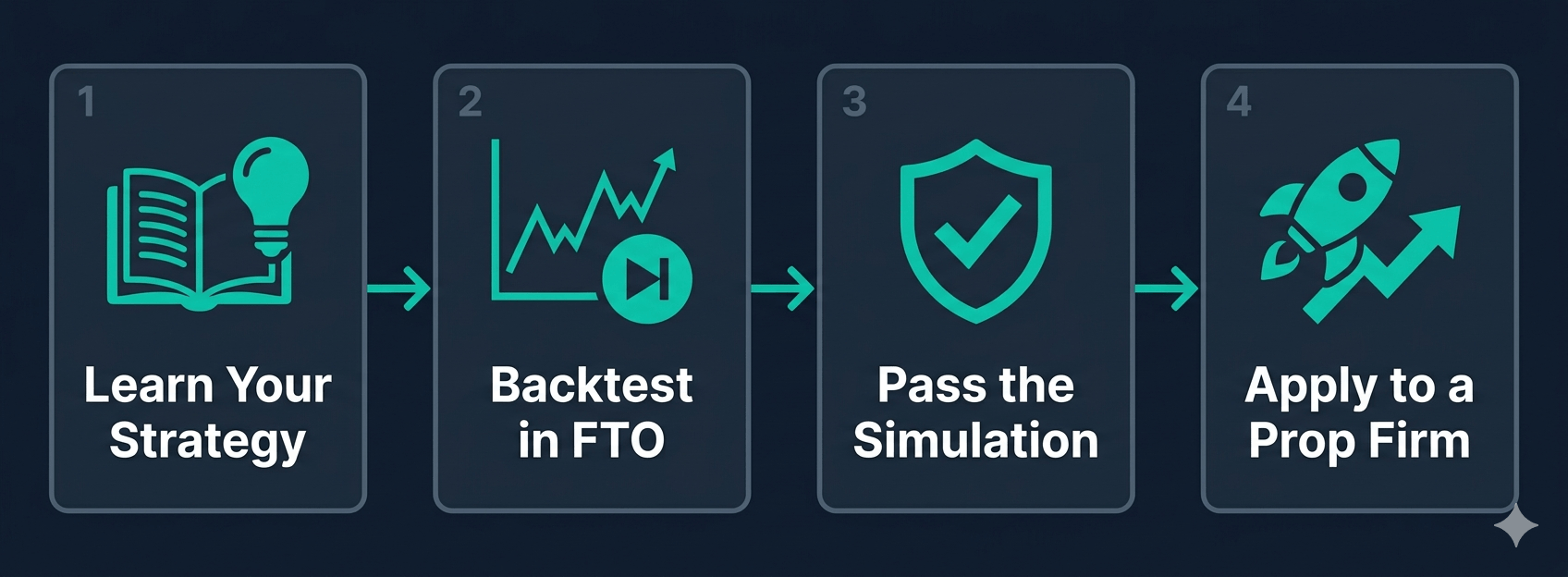
Step 3: Mastering the Prop Challenge Simulation with the Tool to Help You Get Funded
Knowing the rules intellectually and performing under them consistently in live market conditions are two different skills. The gap between them is where the majority of funded account attempts fail — and it’s exactly the gap that a proper simulation practice closes before you spend real money.
Forex Tester Online is a browser-based backtesting and prop challenge simulation platform built for manual traders. It requires no installation, runs on any device, and provides 23+ years of real tick-by-tick historical data across forex, crypto, indices, and metals. Unlike MT5’s bar-based replay — where simulated ticks are generated from candle data rather than recorded tick flow — or TradingView, where true tick replay requires the most expensive subscription tier and is limited to just seven days of lookback, FTO gives you real historical ticks across more than two decades in its base plan. That precision matters for prop preparation: prop firms calculate your floating equity at the tick level, and the mid-candle dip that bar-based platforms miss is exactly what triggers real account terminations.
For prop challenge preparation specifically, FTO includes a dedicated Prop Challenge Simulation mode with these features:
- Prop Challenge Simulation mode — configure the exact daily loss %, maximum drawdown %, and profit target to mirror any firm’s rules. FTO terminates the session automatically when a limit is breached, as the real firm would
- Automation & conditional rules — set a trigger that automatically closes all positions or pauses trading when your daily drawdown reaches a self-defined threshold (for example, 4% when the firm’s ceiling is 5%). This builds the behavioral reflex of respecting a hard stop before real money enforces it
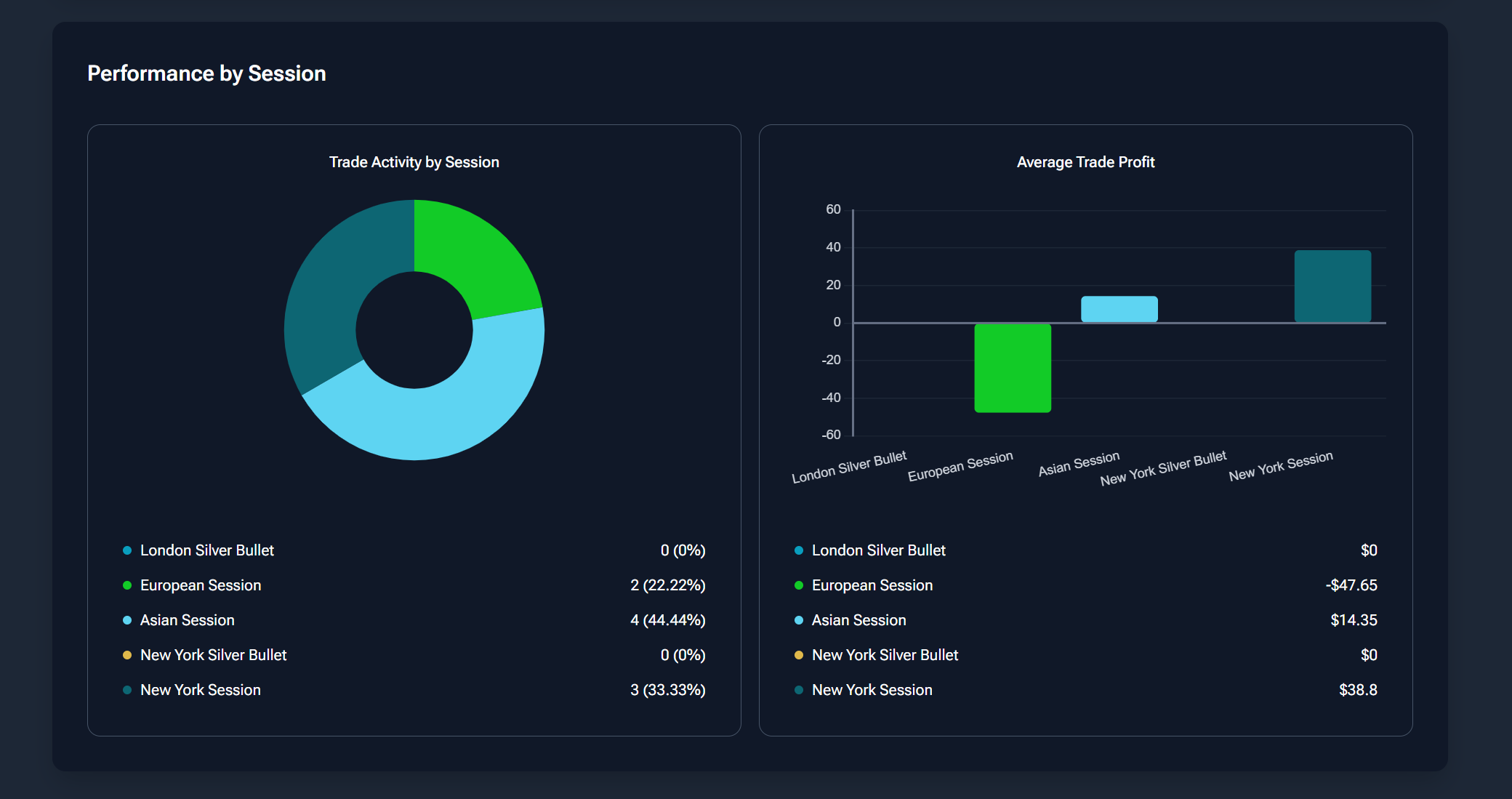
Trade Analyzer — after each simulation run, FTO’s analytics surface which days of the week, trading sessions, and instruments produced your strongest results. If you’re targeting a scale-up from a $50K to a $100K funded account, knowing your statistical edge by weekday is the kind of data that makes that case in numbers rather than intuition
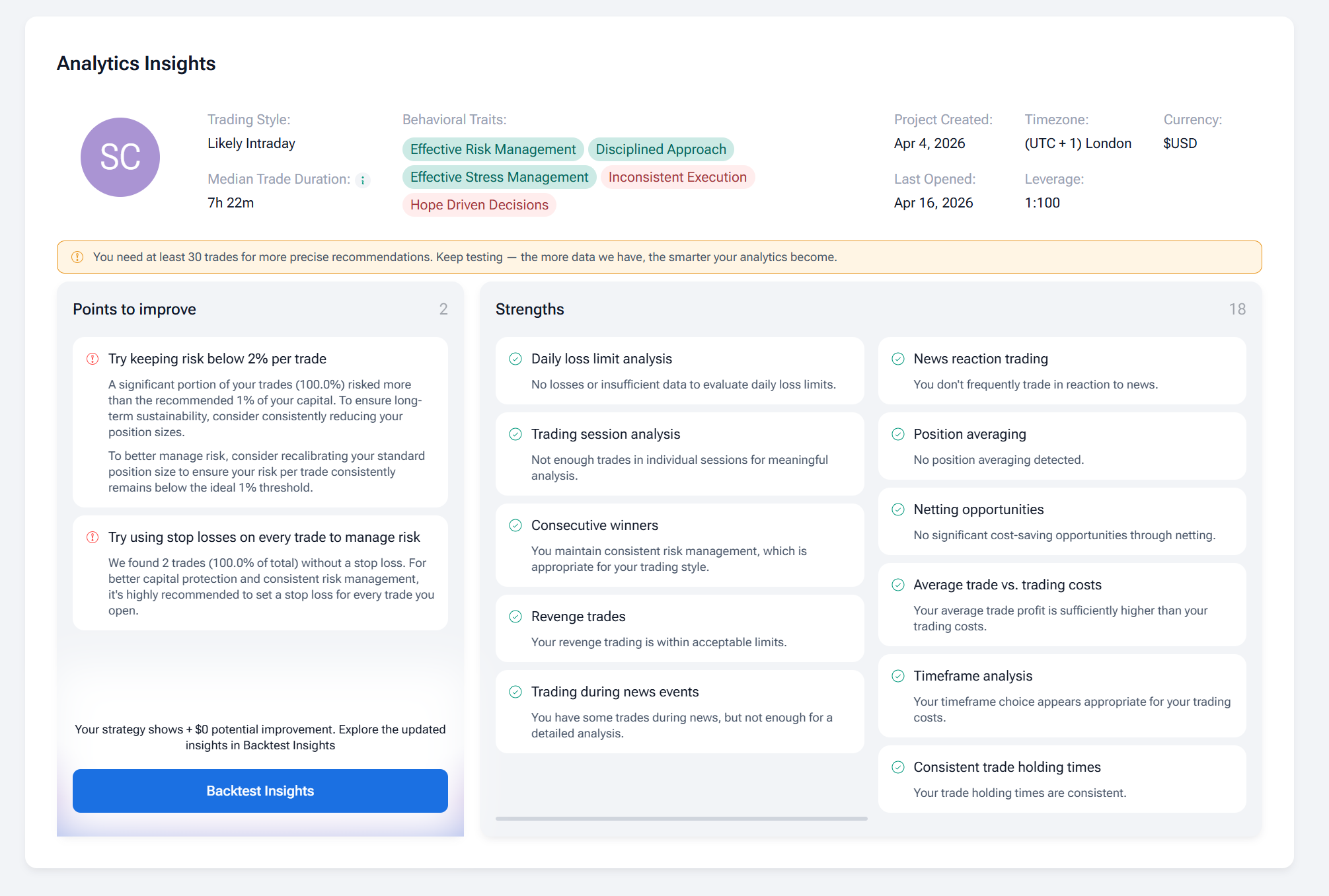
- Blind Mode — for strategies built on pure price action that should theoretically work on any liquid instrument, Blind Mode conceals the asset identity and date. If your edge is real and not tied to chart familiarity with a specific pair, it should hold up on an unlabeled chart — and Blind Mode is the only way to verify that without unconscious hindsight
Step-by-step: how to run a prop challenge simulation before buying any evaluation
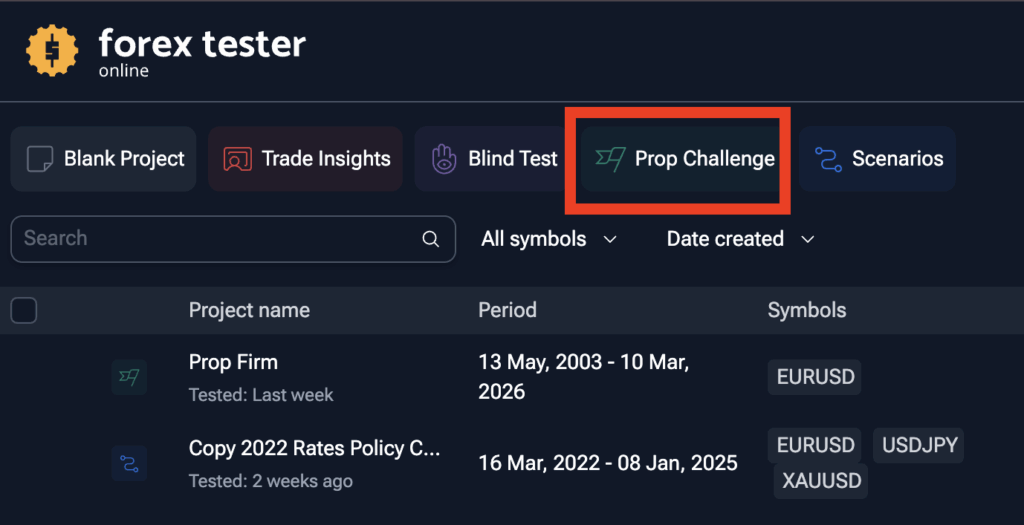
Step 1 — Open Forex Tester Online and go to Prop Challenge. On the projects dashboard, click the “Prop Challenge” tab in the top navigation. Select “Custom Challenge” to configure the exact rules of your target firm.
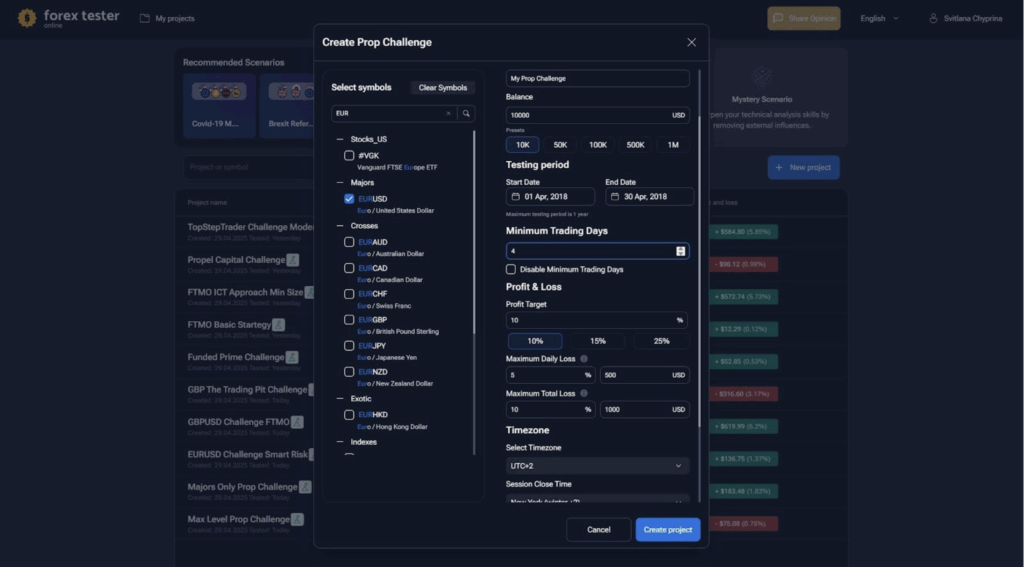
Step 2 — Configure the rules to match your target firm. The setup screen lets you select instruments, choose a historical testing period, and enter the firm’s parameters: Profit Target %, Maximum Daily Loss %, and Maximum Total Loss %. Name the project after the firm so you can compare multiple runs side by side.
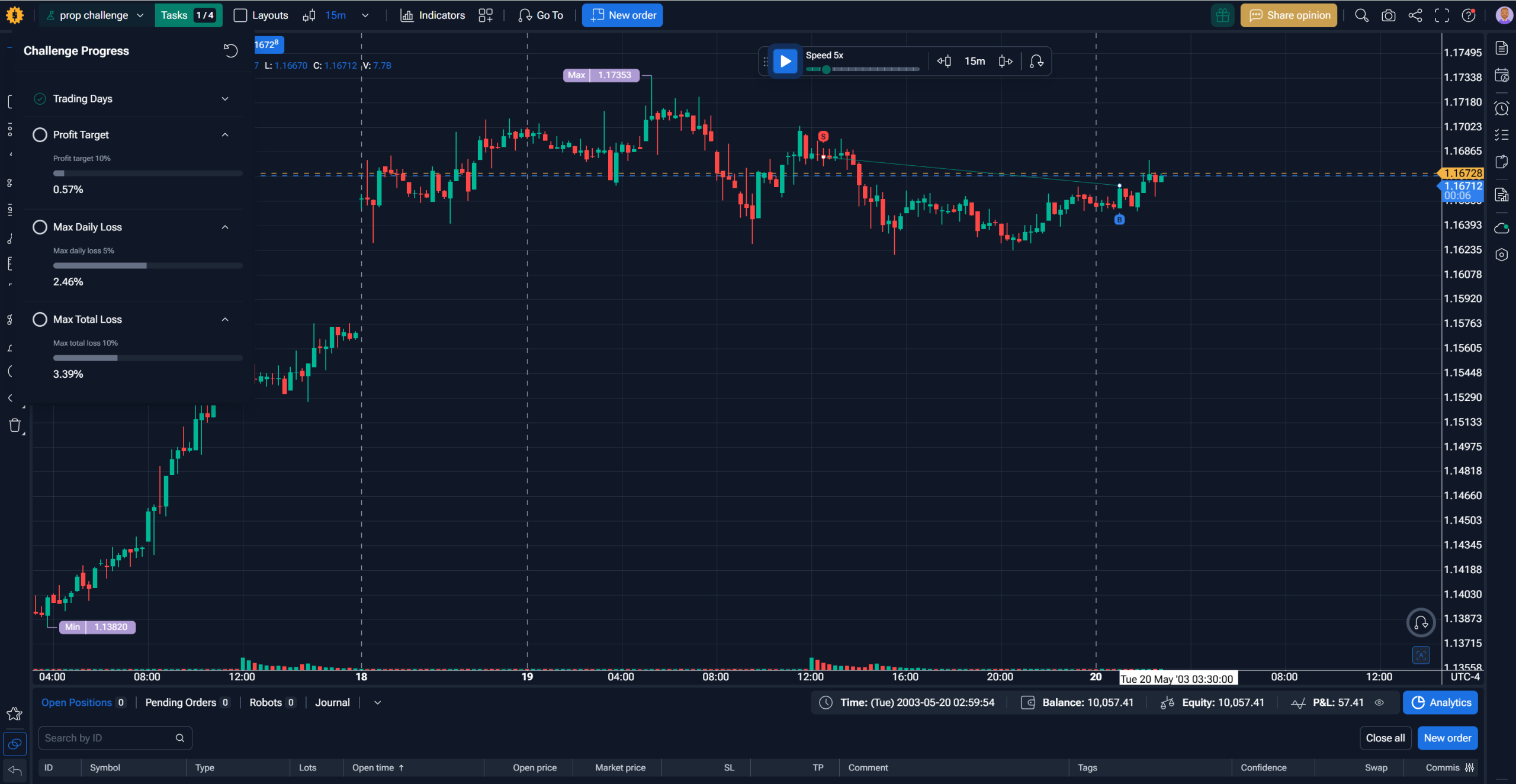
Step 3 — Trade and track your parameters in real time. Once the simulation begins, the Challenge Progress panel on the left shows live tracking of all active metrics as you trade. The economic calendar marks high-impact news events on the price timeline — the same events that spike spreads and breach daily limits in live evaluations. Use Fast Forward mode to compress a full testing period into a single session.
Step 4 — Finish, review, and repeat on different data. When the simulation ends, FTO displays your result and full analytics — including where your equity came closest to the limits and which sessions carried the most risk. Use the Jump To function to reset to the same challenge parameters on a different historical date range. Passing the same conditions twice on different market data means you have actual evidence of robustness — and the entry fee becomes a payment for something you’ve already demonstrated, not a gamble.
Why Most Traders Fail Prop Challenges and How to Avoid It
The rules are clear. The math is simple. Yet the majority of funded evaluations end in the first two weeks — and almost never because the trader lacked a working strategy. The reasons are predictable, and so are the fixes.
The Trap of “Fast Funding” and Overleveraging
The fastest path to a failed evaluation is treating the challenge like a demo account with no consequences. The absence of personal capital at immediate risk tends to unlock the same patterns that have always been costly: oversizing after a losing streak to “recover quickly,” holding a loser through a news event because it “looks like it’ll reverse,” abandoning the tested strategy because today “feels different.”
The arithmetic of this on a prop evaluation is unforgiving. On a $50,000 account with a 5% daily loss limit, you have $2,500 of daily exposure. Risk 2% per trade and you can absorb five consecutive losses before hitting the ceiling — which sounds adequate until a volatile session produces that fifth loss on a position you didn’t close because you were confident in the setup.
Professional prop traders consistently recommend a maximum risk of 0.5–1% of account balance per trade during an evaluation. On a $50,000 account, that’s $250–$500 per trade — numbers that feel conservative but provide 5–10 losses of breathing room before any daily limit is approached. The evaluation isn’t a sprint to hit the profit target. It’s a demonstration that you can generate returns without ever threatening the firm’s capital. Slow and consistent beats fast and volatile every time in a rules-based environment.
Overleveraging also compounds psychologically. A trader who risks 3% per trade and hits two consecutive losses has consumed 60% of the daily limit. Every subsequent trade is made under terminal pressure — which leads either to the oversized recovery attempt that blows the account, or the abandonment of valid setups out of fear. Neither is what funded trading rewards.
Violating Hard vs. Soft Rules (Daily Drawdown vs. Inactivity)
Prop firm rules divide into two categories, and confusing them is one of the more common and avoidable failure modes.
Hard rules trigger automatic account termination the moment they’re breached. The daily loss limit and maximum total drawdown are universally hard rules. There is no appeal, no grace period, and no warning. A floating drawdown that crosses the daily threshold mid-session ends the account immediately — including in situations where the trade would have recovered within the same candle on a less precise data source.
Soft rules are conditional violations — behaviors that may result in a warning, a payout denial, or account review rather than instant termination. Common soft rules include:
- Inactivity requirements — some firms require a minimum number of trading days per month to maintain the funded account. Missing the threshold without notifying the firm can result in account closure, but it’s typically not instantaneous.
- Consistency rules — the 30% single-day profit cap mentioned above is often enforced at payout time rather than in real time. Violating it may not terminate the account but will void the withdrawal.
- Restricted instruments or strategies — high-frequency trading, copying between accounts, and certain news-straddling approaches are banned on most platforms. These are typically reviewed at payout or compliance intervals, not monitored tick by tick.
The practical implication: traders should treat all rules as hard rules for the purpose of their preparation. If the payout can be denied retroactively for a soft rule violation, the economic consequence is identical to a hard rule breach. Simulating your approach under the full rule set — including consistency requirements — before paying the entry fee is the only way to know whether your normal trading behavior is compliant.
Disclaimer
Trading involves risk. This article is for educational purposes only and does not constitute financial advice. Past performance does not guarantee future results. Always test any strategy before committing real capital.
Conclusion
Funded trading is neither a shortcut nor a lottery. It’s a structured arrangement that rewards traders who already have a working system, the discipline to operate within tight risk parameters, and the preparation to know how their strategy behaves before they pay for the privilege of proving it under firm conditions.
The mechanics are learnable, the rules are transparent, and the math is not complicated — but all three need to be internalized before the entry fee is paid, not discovered during the evaluation. Most failures come from treating the challenge as a discovery process rather than a performance process. The traders who pass consistently are the ones who have already passed it dozens of times in a simulator.
If you’re ready to prepare seriously before you commit financially, Forex Tester Online gives you the prop challenge simulation environment, 23+ years of tick-level historical data, and the analytics to understand exactly where your edge is strong enough to survive real evaluation conditions. Cancel anytime. 30-day money-back guarantee.
Frequently Asked Questions
What is a funded trading account in simple terms? A funded trading account is provided by a prop firm to a trader who has passed an evaluation. The trader operates with the firm’s capital — most often in a simulated environment, occasionally on live execution — keeps the majority of profits (typically 80–90%), and follows strict risk rules. If those rules are breached, the account is terminated.
How much does it cost to get a funded trading account? Evaluation fees range from roughly $10 for a $5K instant-funded account to $300+ for $50K–$100K evaluation-based accounts. Some firms refund the entry fee after the first successful payout. The real total cost includes potential reset fees if you fail and restart — which is why most experienced traders simulate under firm conditions before buying any evaluation.
What is the difference between a demo-funded and a live-funded account? This is one of the most common misunderstandings in prop trading. At most popular retail prop firms — including FundingPips, FTMO, Apex, and the majority of firms offering evaluations under $300 — your account remains simulated even after you pass the challenge and receive “funded” status. You’re still trading on a demo environment that mirrors live conditions; your profits are real but paid by the firm, not generated from live market positions. A live-funded model — where your trades connect to real market execution through a registered broker — is less common. Topstep’s final account tier works this way. Confirm the structure of any firm before signing up, since it has implications for regulatory protection and what happens to your balance if the firm has financial difficulties.
What percentage of traders pass prop firm challenges? Industry estimates place the figure at approximately 7–17%, depending on the firm, the program structure, and the account size. Topstep publicly discloses a 16.8% pass rate for their initial evaluation. The most significant predictor of passing is whether the trader has prepared specifically for the firm’s drawdown mechanics — not whether their strategy is profitable in general.
What is a daily loss limit in a prop firm evaluation? The daily loss limit is the maximum amount your account equity can decline in a single trading day before the evaluation terminates. It is typically calculated on floating equity (including unrealized losses on open positions), not just closed trades. A 5% daily limit on a $50,000 account means $2,500 of intraday exposure — including open trade drawdown — triggers automatic account closure.
What is the difference between static and trailing drawdown? Static drawdown means your loss floor is fixed at the initial balance (e.g., $45,000 on a $50K account) and never moves upward, even as you profit. Trailing drawdown means the floor rises as your equity peaks — so if you grow the account to $53,000, your floor rises to $50,350, leaving you with less room than when you started. Static drawdown is generally more forgiving for traders who run profits before experiencing losses.
Can I use a backtesting tool to prepare for a prop firm challenge? Yes — and it’s arguably the most important preparation step available. A backtesting platform with a dedicated prop challenge simulation mode, like Forex Tester Online, lets you configure the exact rules of your target firm and test your strategy against them using real historical tick data. This reveals how close your normal trading behavior comes to drawdown limits before you find out during a live evaluation.
What is a consistency rule in prop trading? A consistency rule typically limits how much of your total profits can come from a single trading day — often 30%. If your total profit is $2,000 and $700 came from one session, you may be non-compliant even if all other rules were followed. Consistency rules are often enforced at the payout stage rather than in real time, which means violations may not be apparent until you request a withdrawal.

Forex Tester Online
Prepare for any prop challenge. Pay when ready